by Wendy Sun
Fun Rating: 4/5

Difficulty Rating: 2/5
What is the general purpose? The purpose of the Morris water maze is to test and study learning and memory in rats or mice.
Why do we use it? The Morris water maze is useful because it measures how well an animal can remember and use cues around the room to find a hidden platform in a pool of water. Scientists can use the water maze to measure the animal’s ability to learn and memorize, which is especially important if the scientist is studying genes involved in brain development or disease.
How does it work?
In the Morris water maze experiment, the animal, in this case a mouse, is put into a big pool of water with a small hidden platform beneath the water’s surface (Figure 1, step 1). At first, the mouse does not know where the platform is. Through multiple rounds of training, the mouse learns where the hidden platform is using spatial cues or shapes placed outside of the pool of water (Figure 1, step 2).
After the mouse gets repeated exposure and practice, the scientists remove the platform for the experimental trial. The mouse’s activity is recorded. Specifically, the scientists record how quickly and accurately the mouse reaches where the platform used to be, and how straightforward the path is (Figure 1, step 3). Through this experiment, scientists are able to study memory ability, brain development, and diseases that affect thinking and memory of animals.
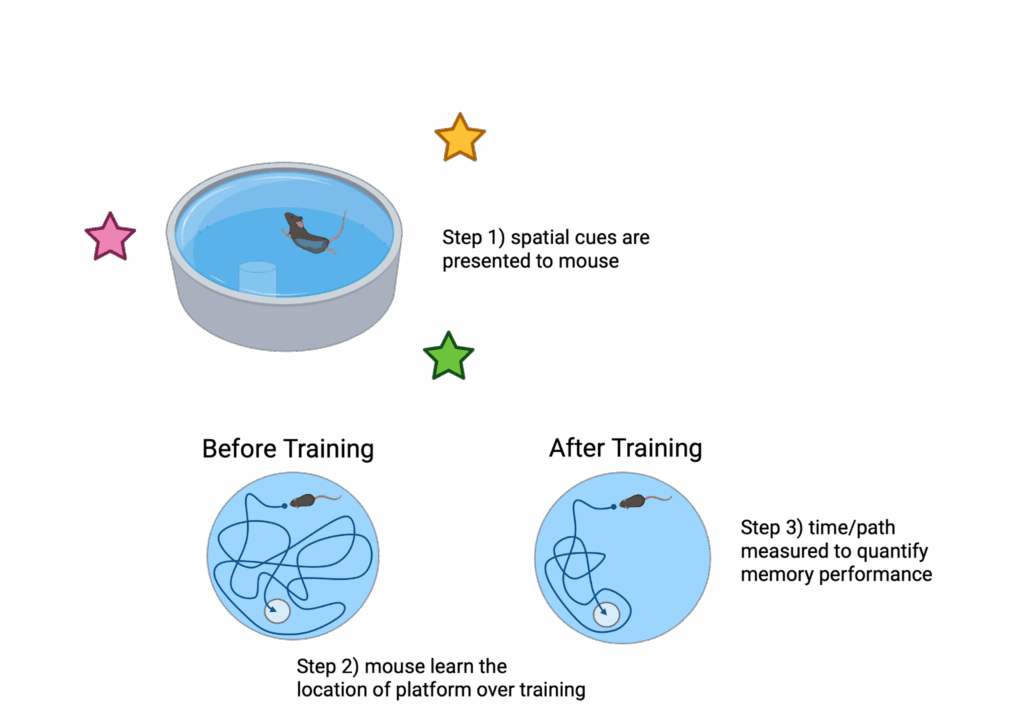
Figure 1. Schematics of Morris Water Maze experiment. Through training, the mouse learns the location of the platform utilizing spatial cues surrounding the pool. The time/path the mouse takes is then recorded for experiment after training. Created with Biorender.
