by Ellissa DeFeyter
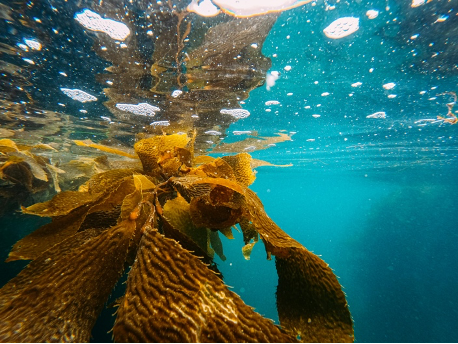
Kelp Photo By Kendel Media
Kelp forests around the world are under threat from factors such as marine heat waves, sea urchin predation, and overharvesting. Conventional methods of helping kelp forests include reducing harvesting, targeting sea urchin culls, and even sending divers into the water to plant more kelp. Although some of these methods have proven successful, they can require a lot of time and energy, and money. Especially those methods that involve sending trained divers into the water to collect kelp either for cultivation or transplanting. In cultivation, divers are needed to collect fronds from kelp that contain spores. Those fronds are brought back into onshore labs to allow propagation. When transplanting, a diver will remove an adult kelp plant from the bottom, carefully place it in a seawater tank for transport to a new location, and then reattach it to the bottom using cable ties.
Within the last five or so years, an innovative new technique called “Green Gravel” has been employed to better restore our declining kelp forests. Kelp spores must first be collected from healthy adults, then the spores are placed on small rocks and allowed to grow. After several months of growing in a laboratory, the kelp saplings are ready to be transported to the ocean. They are simply carried in trays, loaded onto a boat, and then dropped into the ocean once at the desired location. No diving is required for this method, and since the saplings are already anchored to gravel, they stay reasonably secure on the bottom and will continue to grow.
Since green gravel is still so new, an international team of researchers is working together in the Green Gravel Action Group to refine the technique. They are looking into developing a uniform protocol for using green gravel across different regions.
Green gravel was deployed earlier this year in Port Phillip Bay Australia, to help restore multiple declining kelp forest sites. Last year, the same technique was employed in the UK for restoration purposes using oyster shells and gravel.
This restoration method has the potential to improve kelp restoration efforts dramatically due to its simplicity. The other methods mentioned above are more intensive and often don’t work as well. With green gravel, once the kelp sapling grows beyond a specific size, it can simply be thrown from a boat into the water. This allows less-skilled volunteers to help with restoration, rather than trained divers, who are more difficult to recruit due to their specialized skill set.
If you want to learn more about kelp forest restoration efforts and green gravel, check out this academic review paper.
