(noun. /re-STRICT-shun IN-zimes/)
by Hannah Thrash
What does it mean?
Restriction enzymes are found naturally in bacteria and archaea. These unique proteins are enzymes that specifically cut foreign DNA fragments in the organism. For example, if a virus was trying to attack a bacterium, the restriction enzymes would work together to chop up all viral DNA to protect the bacterium. The special thing about restriction enzymes is that each restriction enzyme recognizes its own site on DNA (called a restriction site), and it cuts only at these sites, making them incredibly specific. For example, a restriction enzyme from bacteria called EcoRI cuts DNA only at the GAATTC sequence. Because they work so specifically and cut only at distinct sites, restriction enzymes are useful for humans because we can isolate them from bacteria and use them to precisely cut DNA as the first step in DNA cloning for research and scientific purposes. Restriction enzymes are also important in forensics, as they enable DNA fingerprinting.
How do I use it in a sentence?
“The restriction enzyme EcoRI recognizes a specific and unique site of DNA.”
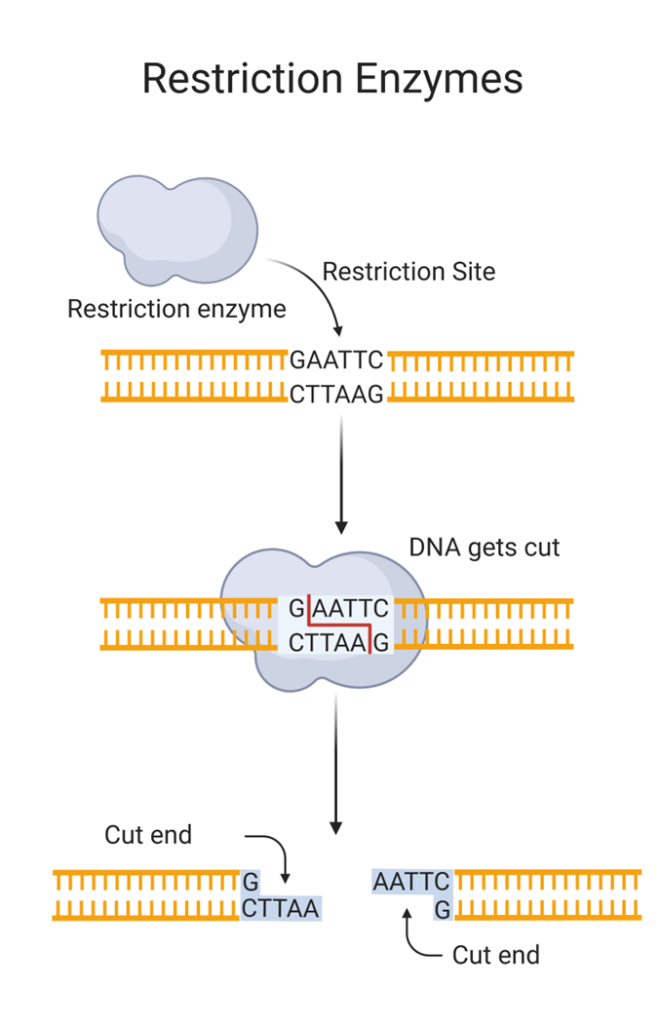
Figure 1: Restriction enzymes find their unique restriction site in the DNA. Then they cut the DNA and create two freshly cut ends. So basically, they are very specific DNA scissors! (Image is the author’s own work; created in BioRender.com.)
History of usage
Restriction enzymes were first discovered in the 1950s-60s, but they weren’t first fully characterized until the 1970s. In 1978, three scientists, Werner Arber, Hamilton Smith, and Dan Nathans, whose work was key to the discovery and characterization of restriction enzymes, were awarded the Nobel Prize in Physiology or Medicine. Since then, thousands of restriction enzymes have been discovered and have been hugely important in molecular biology, specifically cloning and forensics. Read more about the history of restriction enzymes here!
Related terms
Restriction sites
Cloning
DNA ligase
DNA fingerprinting
Fields of study in which this word is commonly used
Molecular Biology
Microbiology
Genomics
Forensics
