(Noun. /OR-guh-noid)
by Yasemin Cole
What does it mean?
An organoid is a miniature, simplified, and specialized version of an organ, grown in a Petri dish from stem cells. Unlike typical cell culture, cells are grown in a 3D structure and self-organize to mimic the complex physiology of real organs. Sometimes, multiple cell types (such as induced pluripotent stem cells or embryonic stem cells) are used, which is more representative of an organ (e.g., brain neurons and surrounding supporting cells).
In cancer research, organoids are especially powerful as scientists can grow tumor organoids from a patient’s biopsy, preserving the genetic architecture and cell diversity of the original tumor. Scientists can then study how the cancer grows, invades into the surrounding structure, and responds to treatments. This is one way scientists are working to personalize medicine, tailoring treatment strategies for each patient.
How do I use it in a sentence?
“The scientist used tumor organoids derived from the patient’s breast cancer tissue to identify which chemotherapy would be the most effective.”
“Neural organoids mimicking specific brain regions allow scientists to study complex neuropsychiatric disorders by better modelling neural connectivity and environment.”
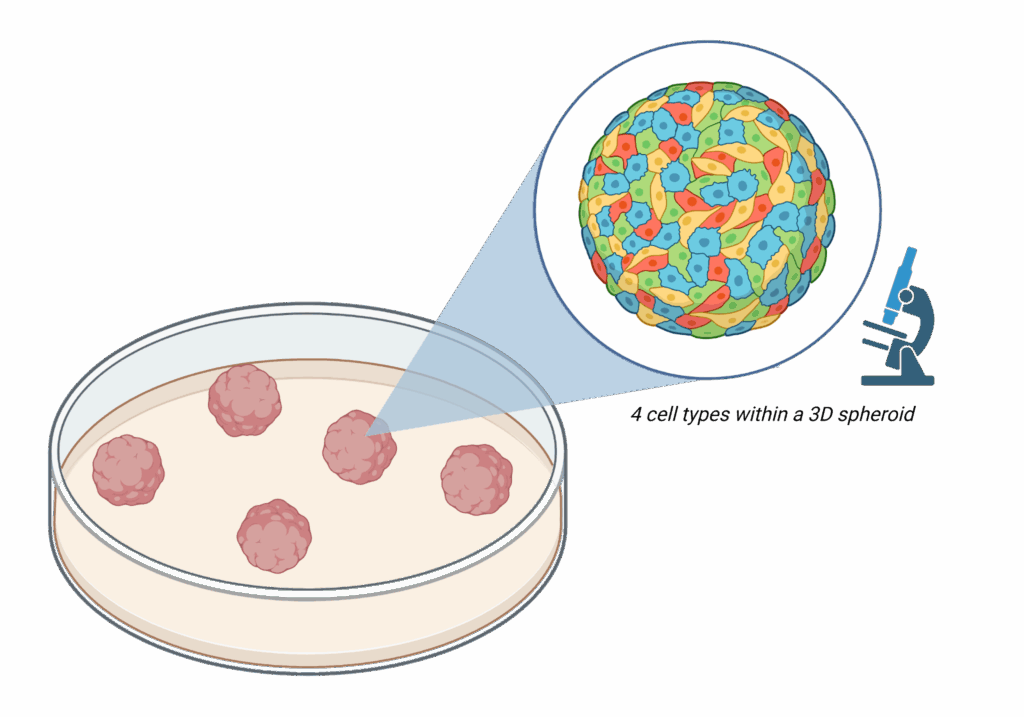
Organoid. Graphical depiction of a tumor-derived organoid in a cell dish, illustrating four heterogeneous cell populations of the tumor. (Created by the author using BioRender)
Etymology
The term “organoid” comes from the Greek word “organon” (meaning instrument or organ) and the suffix “-oid” (meaning resembling). This term was initially used to describe intracellular structures, such as the organelle mitochondria. The term was reutilized in the early 2000s to describe 3D tissue models grown from stem cells. This shift was prompted by breakthroughs in stem cell biology and tissue engineering.
History of usage
The term “organoids” gained traction when scientists realized they could replicate human diseases in a dish. In recent years, organoids have been used to model rare diseases, host-pathogen interactions, and early human development.
Related terms
Stem cell
Pluripotency
3D culture
Precision oncology
Misconceptions (about word usage)
In the media, brain organoids are often referred to as “mini-brains”, which is misleading. They are way more simplified, lacking the size, complexity, and sensory input necessary for sentience and consciousness.
Fields of study in which this word is commonly used
Regenerative medicine
Cancer research
Neuronal development
Genetics
Bioengineering
Edited by Anca Frasineanu
