by Ellissa DeFeyter
Fun Rating: 5/5

Difficulty Rating: 4/5

What is the general purpose?
CRISPR (Clustered Interspaced Short Palindromic Repeats) is an emerging tool used for gene editing and has groundbreaking ramifications for fields such as medicine, agriculture, and bioenergy.
Why do we use it?
Microbes, such as bacteria and archaea, utilize CRISPR as a component of their immune systems. Microbes use CRISPR to cut and remove viral genetic material that has been incorporated into their DNA. The CRISPR system can even “remember” which viruses have already infected the organism and can detect those same viruses if they try to infect the microbe again. Even though CRISPR is a component of microbial immune systems, scientists have harnessed the technique to alter the genetic material of plants, animals, and other microbes. CRISPR is being increasingly used as a method of gene editing, and is preferred over other methods due to the ease of programming and its relatively cheaper cost to employ.
Timeline of CRISPR Discoveries
1993: Dr. Francisco Mojica of the University of Alicante, Spain, discovered palindromic DNA sequences in microbes, coined the term CRISPR, and theorized its role in the microbial immune system.
2007: Dr. Philippe Horvath and a team of researchers published a paper confirming the role CRISPR plays in microbial immune systems.
2012: Drs. Jennifer Doudna and Emmanuelle Charpentier of UC Berkeley and the Max Planck Unit for the Science of Pathogens in Berlin published a paper in Science proposing using CRISPR as a gene editing tool.
2020: Drs. Doudna and Charpentier became the first all-female Chemistry Nobel Prize winners for their discovery of CRISPR’s use in gene editing.

Figure 1: Dr. Emmanuelle Charpentier (left) and Dr. Jennifer Doudna (right) Image Credit (Wikipedia Commons).
How does it work?
CRISPR can be used to delete (“knockout”), insert (“knock-in”), and modify gene expression. The basic components of CRISPR are CRISPR-associated endonuclease (Cas), guide RNA (gRNA), and a protospacer adjacent motif (PAM).
Knockout
In CRISPR, Cas functions as a pair of scissors, physically cutting the target DNA. The gRNA directs Cas to the target DNA sequence that is to be cut. PAMs are short DNA sequences that are located near the targeted DNA region. The Cas will continue cutting until reaching the PAM sequence, which tells the Cas to stop. This prevents non-target DNA regions from being damaged. PAMs were part of the original configuration of CRISPR used by microbes to prevent their own genetic material from being removed by the virus. In a recent example of CRISPR knockout, researchers are investigating the use of knockout technology to delete a gene that plays a significant role in prostate cancer metastasis.
Knock-in
The progress of knock-in, or DNA insertion, begins in the same way as knockout, with gRNA guiding Cas to cut a targeted region of DNA, and PAM halting the cutting. When performing a knock-in, however, the Cas contains a segment of DNA to be added to the cut, known as the donor DNA. This donor DNA can come from the animal being modified, but it can also come from a different species! CRISPR has been used to create transgenic animals, or animals that contain DNA from other species.
Gene Expression Modification
Two modified forms of CRISPR known as CRISPR activation (CRISPRa) and CRISPR interference (CRISPRi), can either increase or silence gene expression. These two forms of CRISPR essentially act like the dimmer on a light switch, and allow researchers to alter gene expression without cutting any DNA. In both CRISPRa and CRISPRi, modified forms of Cas attach to the target DNA, and either enhance or silence gene expression. Researchers can use these “dimmers” to study the functions of different genes by selectively activating and silencing them.
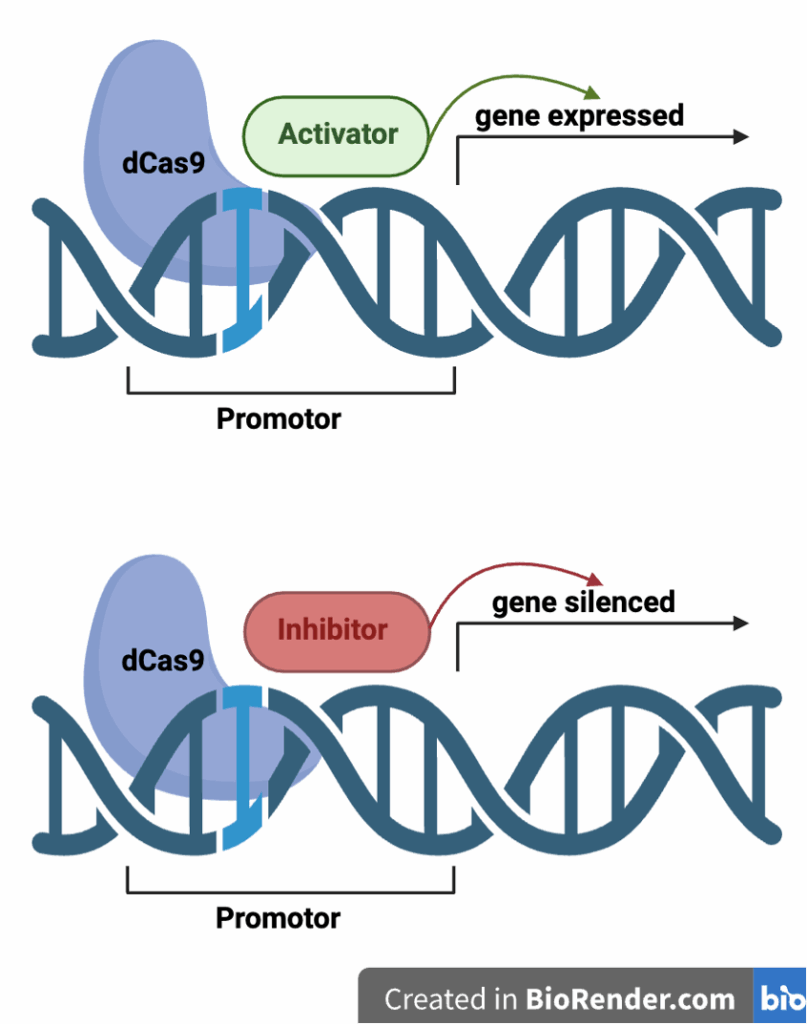
Figure 2: Conceptual diagram of CRISPRa and CRISPRi process (Created in BioRender.com by author)
Are you interested in working with CRISPR in college?
Numerous professors in North Carolina conduct research using CRISPR. A couple of examples include the CRISPR Lab of NC State University, the Bursac Lab of Duke University, and the lab of Dr. Maria Pereira at UNC Pembroke. UNC Chapel Hill also opened a CRISPR Screening Center in 2021, which is available to both UNC Chapel Hill professors and those from other universities.

