by Hannah Thrash
Fun Rating: 3/5

Difficulty Rating: 3/5
What is the general purpose?
Scientists use migration assays to watch and measure cell movement through a membrane.
Why do we use it?
Migration assays help scientists determine how mobile cells are, allowing them to make inferences about how cells might move in real life. For example, how cells might metastasize through the body or an immune cell might migrate through the wall of the blood vessel are both concepts that could be explored with a migration assay. Migration assays also allow cells to be put into various conditions and the change in migration capacity, or change in movement, can be determined. This means that scientists can easily test new ways to make cells move more or less without having to track a cell through a living organism.
How does it work?
Migration assays start off a lot like mammalian cell culture except the cells are plated in a special plate containing transwell inserts. These transwell inserts have a semi-permeable membrane (a special material that only lets things, molecules and particles and such, of a certain size through) on their bottoms that create a barrier in the well that the cells can only travel through if they have the ability to do so. Here are the basic steps (Fig. 1).
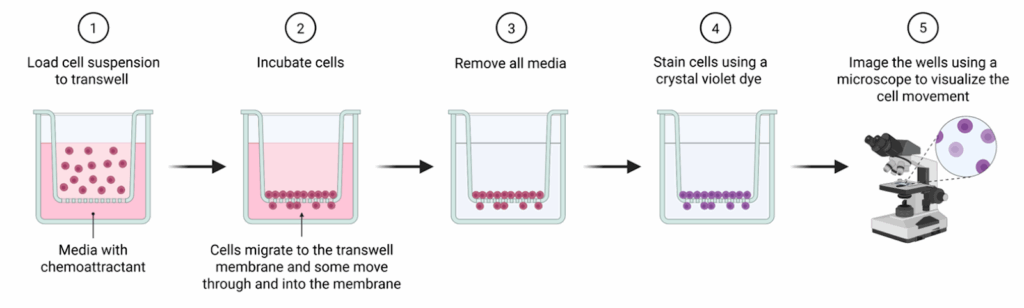
Figure 1. The basic steps to a migration assay. Created in Biorender by author, modified from Biorender template.
Step 1: Load cell suspension to transwell
The key to making a migration assay work is to set up the cells so that they want to move. We do this by providing a chemoattractant – usually something in the media that the cells need to survive but we’ve taken away from their media, like certain nutrients. The cells will want to move towards this thing they need, if they’re able to, allowing us to test their migratory ability. Because of this we first set up our transwell plate by putting the cell media with the chemoattractant into the bottom of the transwell, under the membrane. Then, from your stock of cells, count out the amount of cells you need and get them into a suspended state (meaning not sticking to anything) and put these counted cells on top, above the membrane.
- Note: if there is some kind of drug being used on the cells, to see if it impacts the cells’ movement, you’d probably add that here too!
Step 2: Incubate cells
Cue the Jeopardy theme song! Here we incubate, or leave the cells in a warm, humid place, to allow the cells to actually move. If we are testing cell movement based on some environmental condition, here the cells need to be in that condition.
Step 3: Remove all media
Remove all media, we don’t need it anymore! Just the cells.
Step 4: Stain cells using a crystal violet dye
Crystal violet is a special dye that cells can absorb. When they do, they turn a nice shade of dark purple, allowing us to see them with the naked eye, and enhancing microscope images. In this step the cells are out of the media, so all we need to do is move the transwell with the membrane containing the migrated cells into a bunch of crystal violet solution. We give it 10-30 minutes for the cells to take up all that dye, then use regular water to rinse off any extra dye. This leaves nice purple cells ready for seeing!
Step 5: Image the wells using a microscope to visualize the cell movement
Get that transwell insert under a microscope! All the cells that moved will be nicely purple and able to be seen. The idea is that the more cell movement that occurs, the more cells and the more purple there will be. Conditions where there was less cell movement will result in fewer cells being seen trapped in the membrane and less purple. To quantify the amount of movement, you can count the cells in the images you’ve taken and graph out their numbers to show changes in movement.
And you’re done! There are multiple variations on this method, but in general this is how a migration assay works. This experiment is key to help scientists understand cell movement throughout the body.
