by Christine Side
We all know the feeling – you’re in a place you’ve never been before, taking in your surroundings, and a strange sense of familiarity strikes. You think to yourself, “Why do I feel like I’m living in a memory? This is my first time here.” That sense of remembering a novel experience and recognizing it? That is déjà vu, and about 97% of people say they have experienced it before (about two-thirds experience it regularly)!
Déjà vu is a French term that translates to “already seen,” and it is quite difficult to study because the feeling can be so sporadic and short-lived. Currently, scientists believe that déjà vu occurs because of a miscommunication between two crucial brain regions: the hippocampus (a key area for learning and memory) and the temporal neocortex (a region that primarily compares sensory information with memory). While scientists aren’t sure why deja vu happens, the leading idea is that neurons connecting these two regions may be activated at the wrong time.
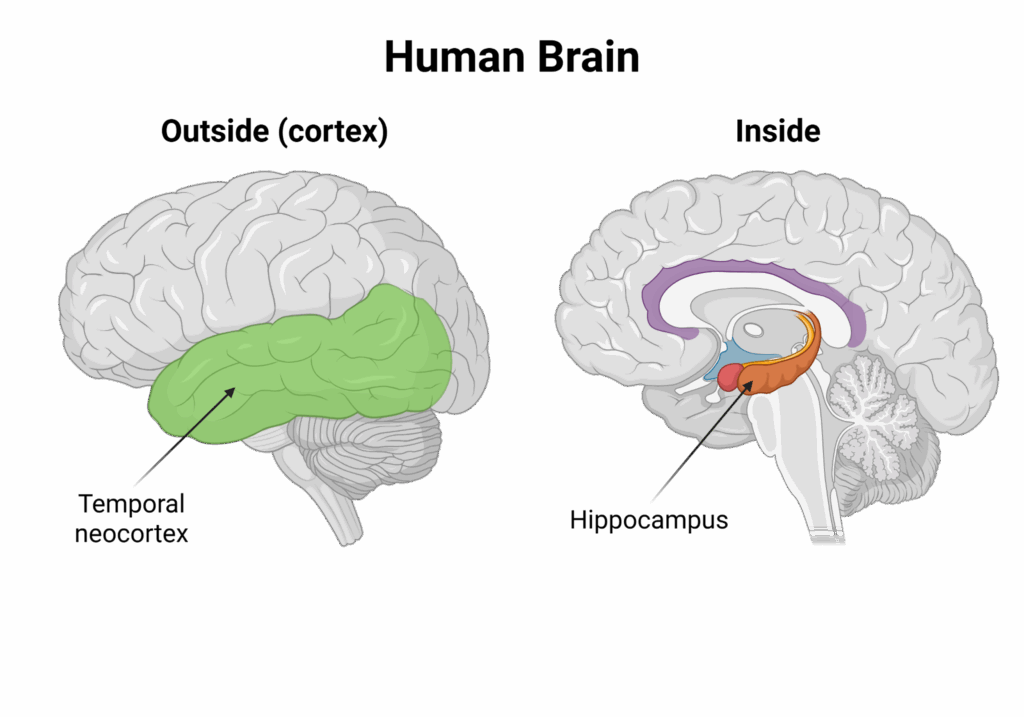
Image: (Left) A graphic of the outside of the human brain with the temporal neocortex highlighted in green. (Right) A graphic of the inside of the human brain with the hippocampus highlighted in orange. Image created by the author in BioRender.
For the vast majority of people, this phenomenon is just an uncanny experience that happens every once in a while. However, déjà vu can also be a symptom of other neurological conditions, particularly temporal lobe seizures. People who experience temporal lobe seizures, like specific individuals with epilepsy, report feeling warning signs (like déjà vu) right before having a seizure. This is called an aura.
Don’t worry – as mentioned before, déjà vu is a normal phenomenon that affects most people and is not typically a cause for concern. Other factors can contribute to how often a person experiences it, including:
- Recent travel. Traveling can throw off your circadian rhythm, making déjà vu more likely. That means changes in how much or when you sleep can also influence the experience.
- Remembering your dreams. Scientists aren’t sure why, but if you’re more likely to remember your dreams, you’re more likely to experience déjà vu.
- Stress and anxiety. Research shows that individuals with anxiety experience déjà vu more frequently and with greater intensity than individuals without anxiety.
So, the next time you have that strange, familiar feeling in a new environment, you can rest easy knowing that it’ll pass (and you’re not alone!). Of course, if you’re concerned that you’re experiencing déjà vu too frequently or if it occurs with other new symptoms, make sure you talk to your doctor.
