Noun. /yoo-bick-wuh-tin/
by Anca Frasineanu
What does it mean?
Ubiquitin is a small protein best known for its role in cellular regulation. Essentially all eukaryotic cells have proteins that become modified with ubiquitin to regulate protein levels, but also localization and function. This process, called ubiquitination, requires three different enzymes, which provide specificity to a tightly regulated process.
How do I use it in a sentence?
“Ubiquitination is a process best known for the addition of poly-ubiquitin chains (composed by multiple ubiquitin proteins) to other proteins, which targets them for degradation by the cells’ destruction machinery.”
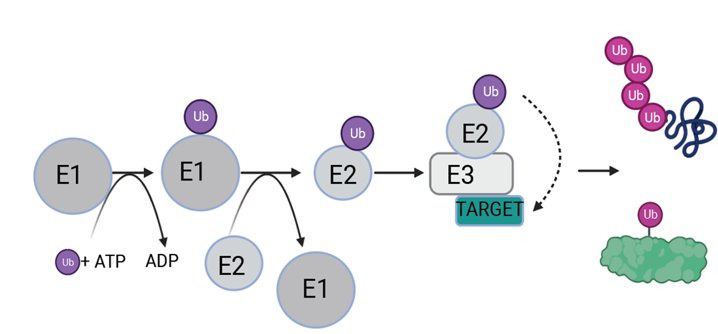
Made with BioRender. The Ubiquitination cascade. Humans have 2 E1 enzymes (ubiquitin-activating) and 38-40 E2 enzymes, which are called ubiquitin-conjugating, as they transfer ubiquitin to the substrate. Over 600 E3 enzymes have been identified in humans, as they provide specificity to the process.
Fields of study in which this word is commonly used
Cell Biology, Biochemistry, Cancer, Neuroscience
