by Claire Greene Whitfield
It is no secret that we have a plastic pollution problem here on Earth. Recent reports tell us that the world produces about 450 million tons of plastic per year, much of which eventually becomes waste. While a large share ends up in landfills, a significant portion finds its way into our oceans. This unfortunate reality has inspired scientists and climate researchers to find creative solutions to managing plastic waste.
Perhaps the most interesting potential solution can be found in nature – in the form of a small, grub-like larva that enjoys pestering beehives across the globe. Galleria mellonella, also known as waxworms, are well known as a pest in the beekeeping community for eating the waxy honeycomb inside beehives. In 2017, a molecular biologist and amateur beekeeper, Federica Bertocchini, collected the pests out of her beehives in a plastic bag. When she returned just a short time later, she discovered that the worms had eaten through the bag!
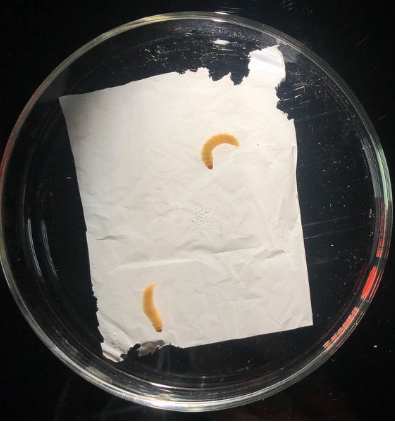
Figure 1. Galleria mellonella larvae (waxworms) on a section of a plastic bag with their bitemarks seen on the corners. Image taken by the author, previously from a waxworm lab.
But why is this special? Some bugs gnawing on plastic may not sound extraordinary, but these findings are quite remarkable. Biodegradation, or the breakdown of organic matter by organisms, is a process that can take years or even centuries. Usually, a plastic bag left outdoors takes about 20 years to break down, but somehow these waxworms were able to break through the material in just a matter of minutes!
How does the waxworm do this? Well, first, we should think about what it means to break something down. As humans, we break down (or metabolize) the food we eat, turning it into energy and nutrients. This happens with the help of enzymes, which act as molecular scissors to break specific chemical bonds, releasing the energy. Why can’t humans biodegrade plastic like waxworms? That’s easy – it’s because we don’t have the proper enzymes (or scissors).
The saliva, or spit, of the waxworm contains lots of these enzymes that allow it to break the chemical bonds in the plastic. Scientists, including Dr. Bertocchini, have recently identified and named these enzymes (shown below). These findings inspired the foundation of Plastic Entropy, a company that has figured out how to use these enzymes outside the lab to break down plastic in just one hour! By continuing to study these enzymes, scientists are hopeful we can learn lessons from the waxworm to help solve our plastic problem!
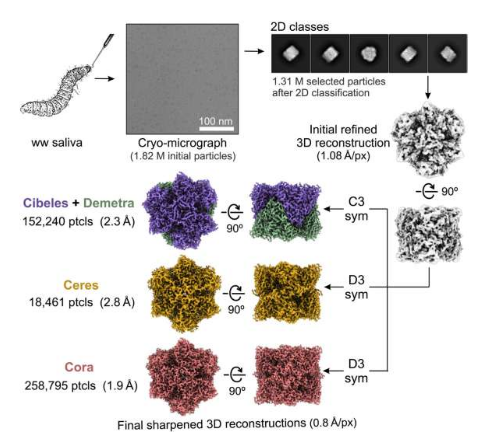
Figure 2. Image from Dr. Bertocchini’s work on the plastic-degrading enzymes (DOI: 10.1126/sciadv.adi6813)
To learn more about how waxworms are used in science labs around the world, check out this cool video from the Galleria Mellonella Resource Center in the UK: https://youtu.be/CfDlo6-o2_M?si=8l7x3yAKiKZttPcb
