Noun. /lie-sAH-som/
by Hannah Thrash
What does it mean?
The lysosome is a membrane bound organelle found within almost all animal cells. Its role is the cell garbage can; lysosomes are filled with hydrolytic enzymes, special proteins that break down anything and everything that the cells no longer need. For example, if a cell has too much of one protein, or a protein is made incorrectly or is too old and isn’t working properly, the lysosome takes in those proteins and degrades them. Also, lysosomes can also break down captured molecules that have a potential to hurt the cell. Lysosomes also store cholesterol and are important for cholesterol pathways in cells.
How do I use it in a sentence?
“The lysosome is an important organelle and helps keep the cell clean and organized.”
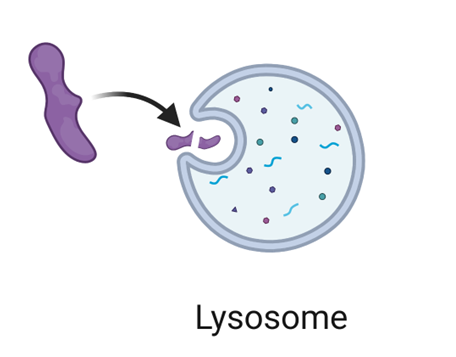
Figure 1: The lysosome takes in cellular trash and degrades these molecules for recycling and disposable. (Created in Biorender by author.)

Figure 2: The lysosome is an important organelle in animal cells. It is one of many organelles, but it has a unique function in that it helps keep the cell clean. Because it keeps the trash down in the cell and disposes of unneeded or broken proteins, the other organelles can continue to function with greater efficiency. (Created in Biorender by author.)
History of usage
Lysosomes were discovered by a Belgian scientist named Christian Rene de Duve in 1955. He won part of a Nobel Prize for his discovery of these organelles! The discovery of the lysosome was also a part of the movement that created modern cell biology – the movement where scientists really started studying the inside of cells to figure out what they were made of and how everything worked together! The idea is that if you know what the cells are doing, you can figure out more about the body. The discovery of the lysosome helped scientists realize there was more going on in a cell than just DNA and they wanted to learn more.
Related terms
Peroxisome
Organelle
Degradation
Fields of study in which this word is commonly used
Biology
Cell Biology
Cancer Biology
