by Anicka AbiChedid
You might have heard the phrase “mind-muscle connection,” which refers to thinking about the muscles we hope to activate during exercise. As it turns out, our body also has its own way of creating the reverse, a muscle-to-mind connection.
Physical activity has long been associated with an assortment of cognitive benefits. In a study conducted with healthy older adults, those who completed a three-month training program showed increased blood flow and blood volume in the hippocampus, the region of the brain responsible for memory and learning. Older adults who exercised also showed improved ability for their brain to change and adapt (known as hippocampal plasticity).
Participants who exercised saw improvements in two types of memory critical for daily life: recognition and recall. Recognition memory is the type of memory used when recognizing a familiar face, a route you have driven before, or recalling where you might have placed your keys. Recall memory is the ability to remember something you learned just a few minutes ago, such as following a set of directions or remembering what was on your shopping list.
What is the biology behind these cognitive effects? During exercise, skeletal muscle fibers increase production of a protein named PCG1a. This protein turns on a gene that makes a second protein, FNDC5. FNDC5 is broken apart to make a smaller, hormone-like molecule called irisin. Irisin exits the cell and travels through the bloodstream, in part due to its small size, thereby affecting organs such as the brain. Once inside the brain, irisin increases the amount of a protein called BDNF, which you can envision as a fertilizer for brain cells. BDNF helps neurons survive, grow new branches, and form stronger connections with each other. This pathway is shown in Figure 1.
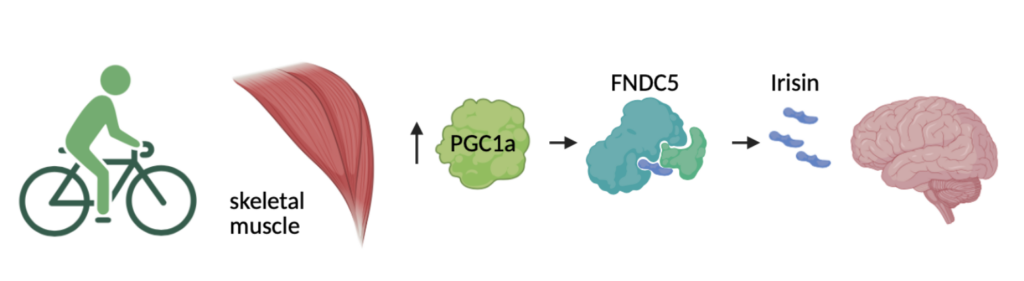
Figure 1. During exercise, PGC1a levels increase, leading to an increase in FNDC5, which is cleaved to form irisin. Irisin then exits the cell, enters the bloodstream, and reaches the brain, where it exerts its cognitive effects. Figure created by author using Biorender.com
Irisin is the molecule responsible for the cognitive benefits of exercise. In another study, mice born without irisin still exercised but did not receive the normal benefits of exercise, including improved memory and healthy neuronal growth. These negative effects were remedied by administering irisin into their blood. Not only is irisin linked to improved brain function, but is also required to see the benefits exercising has on memory.
Beyond its implications in exercise, researchers found that administering irisin to mouse models of Alzheimer’s disease improved memory and reduced symptoms. These findings may help develop new treatments for Alzheimer’s, although more work is needed to precisely characterize irisin’s mechanism of action and suitable treatment options.
So, whenever you go out for a run or ride, your muscles are communicating to your brain through a molecule called irisin, which helps improve your memory and promote the healthy growth of neurons.
