Noun or noun phrase / jum-ping-gene / tran-spow-zon
by Ahana Mallick
What does it mean?
A jumping gene is a gene that has the ability to ‘jump’ from one region of the genome to another. It is also called a transposon and was first discovered in the 1940s by Barbara McClintok.
How do these genes move?
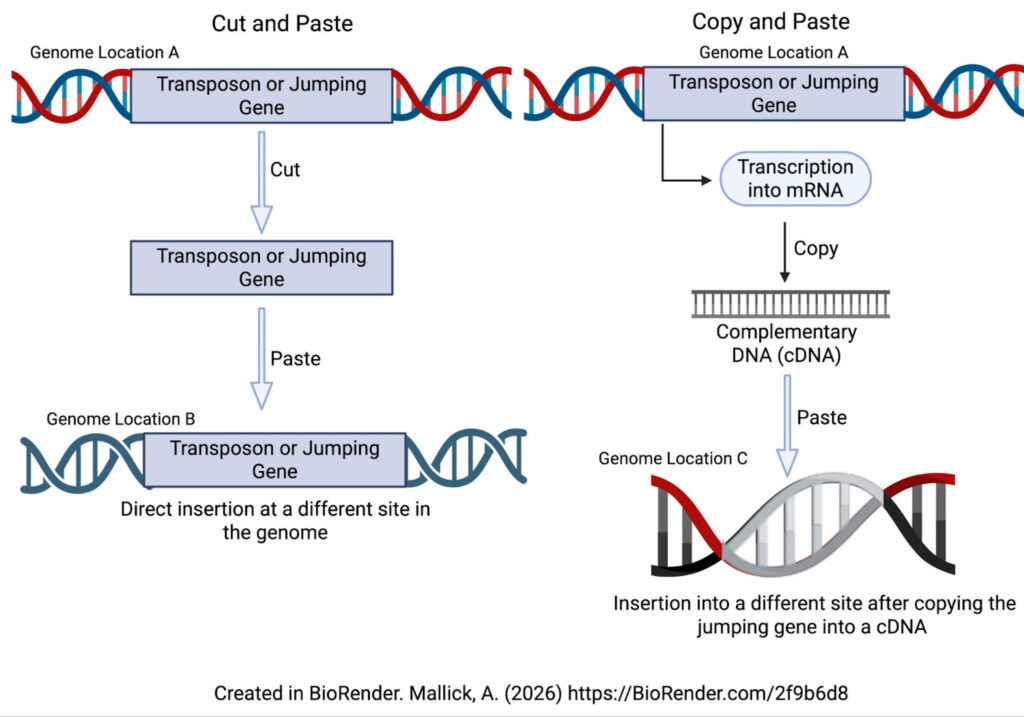
These genes can move from one location of the genome to another in one of the two following ways:
1. Cut and Paste Mechanism: In this mechanism, the jumping genes are simply cleaved (cut) out of their location in the genome and then get directly “pasted” (added into) at a different site.
2. Copy and Paste Mechanism: Some jumping genes are first copied into a complementary DNA or cDNA strand via an mRNA. This cDNA then inserts itself into a different genome location.
How do I use it in a sentence?
“Barbara McClintock won a Nobel Prize for discovering how transposons or jumping genes move around within a genome.”
Etymology
The word transposon was coined by combining transpos(-ition) (from Latin transponere) and the suffix -on (suggesting a functional unit).
History of Usage
The term transposon was coined in the 1970s to describe jumping genes. The term “jumping genes” was coined by Barbara McClintok who discovered them in the 1940s.
Fields of Study in which this term is commonly used
Genetics, Cancer Biology, Evolutionary Biology, Molecular Biology, Gene Editing
