By Kelly Eick
Imagine that several students at your school get sick with the same illness in a month. To understand how everyone got sick, you might start thinking about who got sick first and if they all share the same class. Scientists can investigate these situations through a combination of biological principles, computer programming, and public health called genomic epidemiology.
What is genomic epidemiology?
Epidemiology is the study of how diseases spread through populations, where they came from, and how they can be prevented. Genomics is the study of an organism’s DNA, known as its genome, to understand its behavior. Genomic epidemiology combines these two fields to understand how infectious diseases spread by analyzing changes in the genetic material of pathogens, commonly either bacteria or viruses.
Each pathogen has a unique genome that scientists can identify and compare. While two bacteria might have very, very similar DNA sequences, the sequence can still be different in a few positions, which we call mutations. Tracking the accumulation of these mutations allows us to predict where a bacterium originated from.
How does it work?
Genomic epidemiology is used when a pattern in infections is identified. In a hospital setting, a doctor might notice that several of their transplant patients have been diagnosed with the same bacteria. That doctor now has two pieces of evidence that the infections are related: the same patient population (transplant patients) and the same infectious disease.
They might then recruit a team of scientists to perform DNA sequencing on the bacteria from each person’s infections. The researchers will look at each DNA sequence and determine how many nucleotides are different between the bacteria from each person’s infections. Samples that are more related than random chance (sometimes fewer than 25 mutations across the entire genome!) can indicate recent transmission or a shared source. In Figure 1, Sequence C and Sequence D are the same except for one position, which could indicate a similar source. This evidence alone is insufficient to prove transmission.
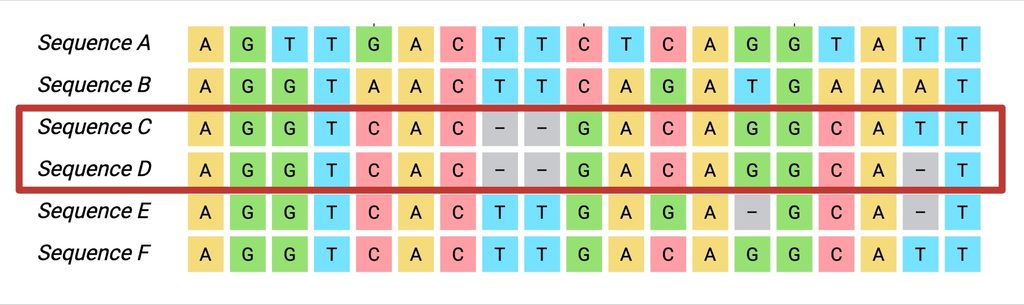
Figure 1. This image depicts several DNA sequences which are related. The red box highlights two sequences that could be evidence of transmission between patients. Image created with BioRender.
Once the genomic evidence shows signs of recent transmission, the team will consider where each patient stayed during their time in the hospital, when they got sick, and other possible sources of the bacteria. If they can determine a shared location, they might collect more samples from the environment to sequence and compare. If the environmental sample is closely related to the patient samples, they now have strong evidence of transmission.
Why is this important?
Genomic epidemiology is an important tool for limiting the spread of infectious diseases. Identifying sources of infection or transmission chains allows us to prevent the further spread of these diseases. During the COVID-19 pandemic, many countries used contact tracing to slow the spread of the virus. Behind the scenes, scientists were collecting and sequencing virus samples to understand how the virus was changing as it moved throughout the population. This is a high-impact example of genomic epidemiology.
As the world becomes more connected, infectious diseases can spread across communities and borders more easily. Genomic epidemiology gives scientists a powerful way to trace these diseases, understand how they are changing, and identify potential sources of infection. By combining genetics, technology, and public health, researchers can help prevent future outbreaks and protect communities worldwide.
