by Natalie Thomas
Fun Rating: 4/5

Difficulty Rating: 5/5

What is the general purpose?
Mouse models are used worldwide to study human diseases, particularly when the disease in question is complex or affects multiple organ systems or cell types differently. For example, skin cancer is fairly benign on its own, but once it metastasizes to an organ like the lungs or brain, it can be deadly. To study diseases resulting from a genetic change, as opposed to an infection or exposure to a toxic substance, we need to be able to mimic that change in the mouse. The Cre Recombinase system is one way this can be done!
Why do we use it?
The Cre Recombinase system enables us to turn genes on or off, or even express new genes, which ultimately help us understand their effects on the body. Furthermore, the Cre system can also be restricted to specific cell types, allowing us to study the precise interactions between “healthy” cells and “sick” ones in detail. This system provides scientists with a flexible approach to better understanding how diseases work and how we might treat them.
How does it work?
Overview
The Cre Recombinase system relies on two major components: (1) the Cre Recombinase (Cre) itself, and (2) Lox Sites. Cre recombinase is an enzyme that acts as a pair of scissors, only for DNA instead of paper. Lox sites are short sequences of DNA that serve as a guide for the Cre enzyme, indicating where to cut. Neither Cre nor the Lox sites will have any effect on their own; both need to be present in the same cell to cause a genetic change, or Recombination.
Cre Driven Cell Specificity
Say you’re interested in studying breast cancer. Many genetic mutations associated with causing cancer can cause problems throughout the body, but right now, the only thing you care about is what happens when this gene is mutated in the breast, which is referred to as the “mammary gland” in mice. To target the mammary gland specifically, you would want to identify a gene that is only transcribed in mammary tissue. You will then use that gene’s promoter to drive transcription, or expression, of Cre!
Knockout Gene of Interest
One use of Cre is to knockout genes. In Figure 1 below, we can see how this can occur. First, you would select the gene you’re interested in. If we’re still interested in breast cancer, we could target the gene TP53, a tumor suppressor gene that is commonly mutated to a non-functional form, causing cancer to grow. Rather than mutate TP53, and possibly complicate our results, we can remove it completely using Cre! Lox sites can be placed on either end of the p53 gene, knocking p53 out of any cell that is expressing Cre. If we use our breast-specific promoter from before, we would expect to see mammary tumors form in the mouse. If instead we promoted Cre with a lung-specific promoter, we would expect to see lung tumors instead! In both cases, though, the tumors would be caused by the knockout of TP53. See Figure 1.
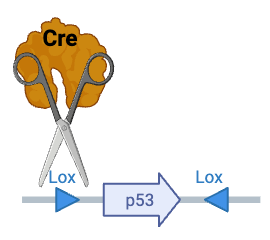
Figure 1. Cre action on Lox sites flanking the p53 gene results in the knockout of the p53 gene in cells expressing Cre. (Generated by author in BioRender)
Knockin Gene of Interest
We can also use the Cre system to knockin a gene of interest! Continuing with the breast cancer example, maybe we are specifically interested in HER2+ breast cancer. We can use Cre to promote the overexpression of HER2, a common oncogene in human breast cancer. To do this, we will insert our gene into a location in the genome known as the Rosa Locus. The Rosa locus is a region of the genome that is constantly accessible but does not interfere with other genes. Our insert has 3 main parts: The first is a ubiquitous promoter, which is active in all cell types. The second is a stop codon flanked by two Lox sites. And the third is our gene of interest, in this case, HER2. We will continue to use a mammary promoter, causing overexpression of HER2 in mammary cells in the mouse, which can induce tumor growth. See Figure 2.

Figure 2. Cartoon visualization of a Cre-mediated gene knockin. A stop codon prior to HER2 is present in the genome of cells that have not been exposed to Cre, but is removed upon Cre activation, allowing expression of the HER2 gene. (Generated by author in BioRender)
Other Applications of the Cre Recombinase System
The Cre recombinase system is used across many eukaryotic model systems and is not specific to mice. Fruit flies, zebra fish, cultured cells, and even plant systems can utilize the Cre recombinase system to change gene expression! In addition to studying oncogenes, Cre can be used for lineage tracing, to study development, or even to test potential therapeutic molecules! With some creative thinking, the applications of this system are endless! To learn more about the Cre-Lox system and other recombinase systems in mice, check out this link!
