(noun /an-a-LIT-i-cul BAL-anse/)
by Claire Greene Whitfield
What does it mean?
An analytical balance is a device that can be used to precisely measure the mass of chemicals and small objects in a laboratory setting. It works a lot like a normal bathroom or kitchen scale, but for very small amounts and with extreme accuracy – down to 0.0001 grams or 1/10th a grain of salt!
How do I use it in a sentence?
“I used the analytical balance to measure my reagents.”
“Please make sure to clean the analytical balance between each use!”
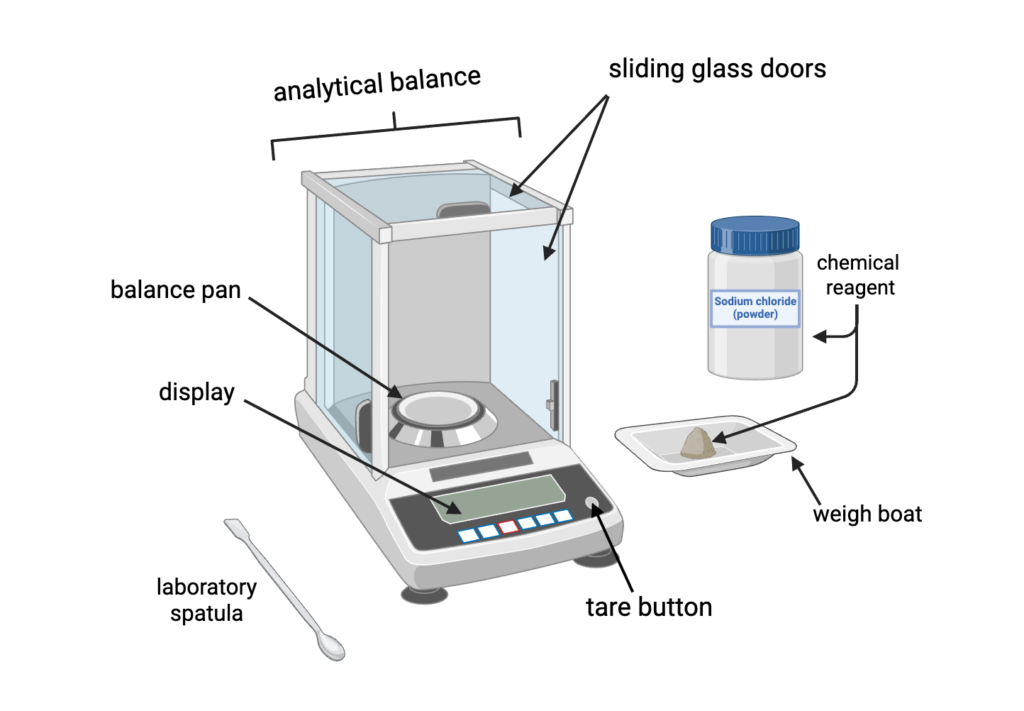
Analytical balance and associated tools. Pictured above is an example of an analytical balance with sliding glass doors, a display, control buttons, and a pan for placing objects/reagents. A laboratory spatula and a weight boat are often used with analytical balances to carefully measure small amounts of reagents onto the balance pan (an example is shown to the right of the balance). Figure created by the author using Biorender.
History:
Many sources report that the first balances were invented in ancient Egypt. Modern scales, like the analytical balance, convert the force exerted by the object being weighed into electrical energy, providing the user with a digital output.
Fields of study in which this word is commonly used: organic chemistry, biology, pharmacology
Related terms:
Scale, mass, accuracy, measure, balance
