(noun. /druhg ree-ZIS-tense/)
by Chloe Gulbronson
What does it mean?
Drug resistance occurs when cells continue to survive after being treated with a medicine that should normally stop them from growing. This phenomenon is observed in both bacteria and cancer.
In bacteria, this is called antibiotic resistance. Bacteria reproduce incredibly fast, and sometimes chance mutations give a few bacteria the ability to survive an antibiotic. The few cells that survive keep multiplying, and suddenly you have a whole population of bacteria that the drug can’t touch. This is why doctors urge you to finish your full course of antibiotics, because stopping early can leave behind bacteria from the infection, giving them a chance to take over.
In cancer, the idea is similar but the mechanisms can be even more complex. Tumor cells might create ways to pump the drug out before it can act, switch on backup programs that bypass how the drug works, or even change their entire identity to become a different type of cell that the drug wasn’t designed to hit. Resistance can be intrinsic, meaning some cells were never sensitive in the first place, or acquired, meaning cells that initially responded find ways to escape treatment over time.
How do I use it in a sentence?
“Doctors prescribed stronger, secondary antibiotics after tests showed that the infection had developed drug resistance to the first medication.”
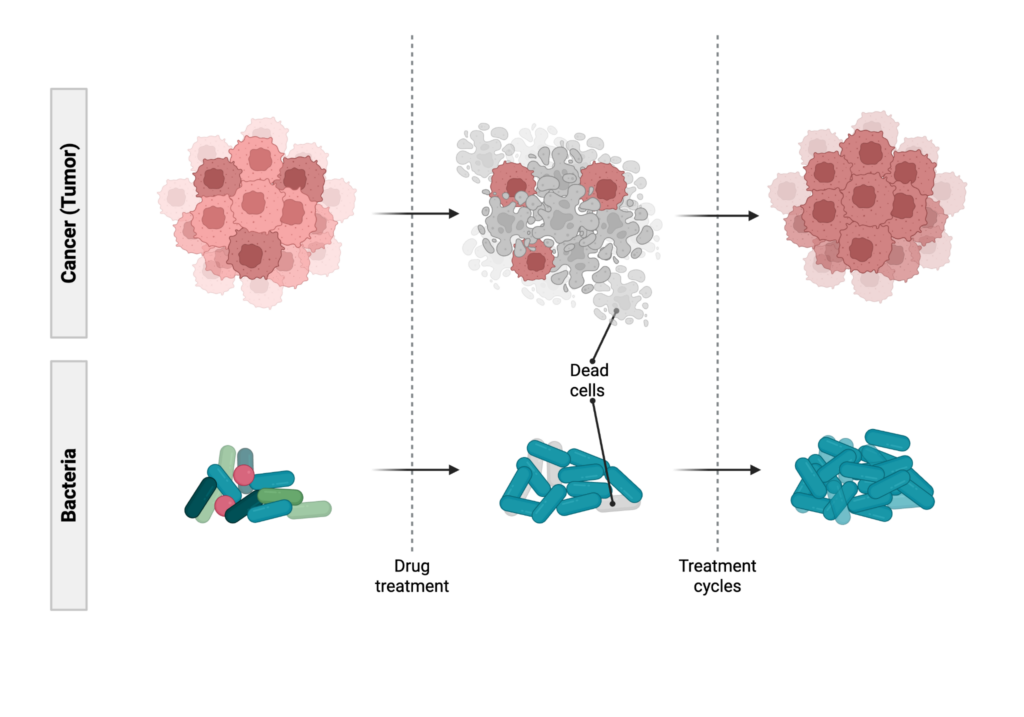
Figure 1. How drug resistance develops in both tumors (top row) and bacteria (bottom row). In the first stage (left), a mixed population of cells is shown before treatment. The tumor contains cancer cells of different shapes of pinks and red, representing different subpopulations, and the bacterial colony contains a mix of different colored bacteria (teal, green, pink, and dark blue). After drug treatment (middle), most cells have died (shown in gray) but a few resistant cells survive. The darker red cancer cells and the teal bacteria remain alive among the dead cells. In the final stage (right) after continued treatment, the surviving resistant cells have multiplied and now dominate the population. The tumor and bacterial colony are made up entirely of the resistant cells. Drug treatment can unintentionally select for resistant cells, allowing them to take over the population. Image is the author’s own work from BioRender.
Etymology
The term combines “drug,” from the Middle English drogge (a substance used in medicine), with “resistance,” from the Latin resistere, meaning “to stand against.”
Fields of study in which this word is commonly used
Oncology, pharmacology, microbiology, infectious disease, evolutionary biology, genomics
