by Hannah Thrash
How do oxygen levels impact cancer? To answer this question, we have to consider why oxygen is important for the healthy body. Oxygen is required in the body’s process of breaking down sugars to make fuel. This makes it essential to maintain enough energy to sustain life! Oxygen is inhaled when we breathe and travels through the body from the lungs to the cells via the blood vessels (vasculature). As the heart pumps, it pushes out oxygen to every cell in the body.
However, sometimes the body doesn’t get all of the oxygen it needs. Hypoxia is a state in which the body is low on oxygen. While this may seem concerning, we often experience temporary hypoxia that does not harm the body. Think about going for a long run or holding your breath underwater. When you finish, you just can’t seem to get enough air! During this time, your body naturally enters a hypoxic state. For times like this, our body has built-in systems that temporarily maintain the function of the body until it returns to a normal oxygen state. Once oxygen levels return to normal, the hypoxic response turns off, and cellular processes resume.
In cancer, tumors grow so quickly and form such large masses that the blood vessels responsible for delivering oxygen to the tumor can’t keep up. Instead, oxygen has to diffuse from the closest blood vessels into the rest of the tumor, making it very difficult for oxygen to reach every single cell in the inner parts of the tumor (Figure 1). This means that most tumors live in a constant state of hypoxia. The body is wired to adapt to brief hypoxia, but constant low oxygen can lead to cell death and rewiring, causing these cells to function differently than the rest of the cells in our body. Additionally, the cancer cells most deprived of oxygen die on their own. This dead tissue forms an area of the tumor that we call a necrotic core. While the presence of this dead tissue is not ideal, it does mean that less of the tumor is growing and spreading.
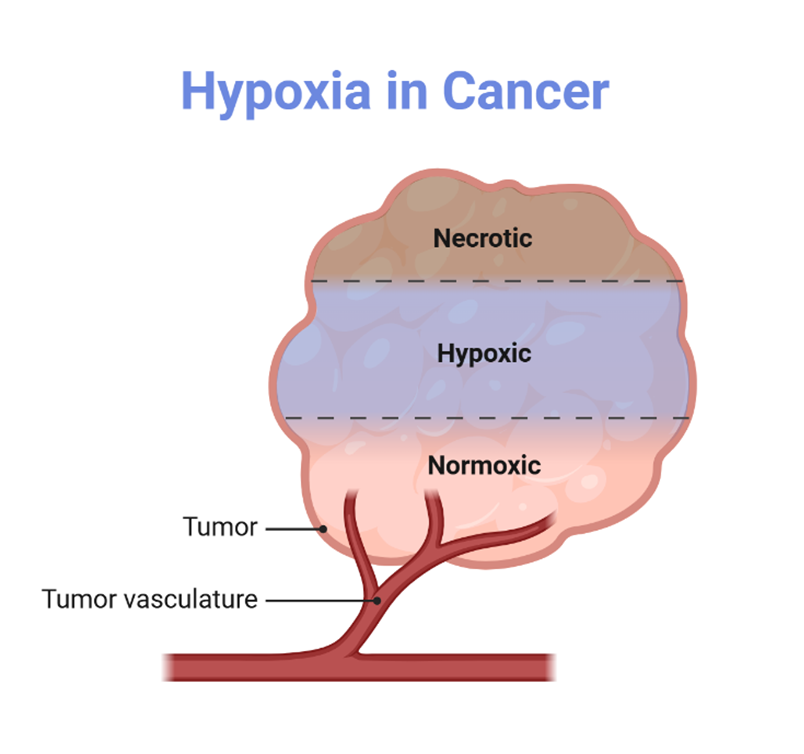
Figure 1: Cancer tumors are large masses of cells with an incomplete blood vessel system, making it very difficult for oxygen to reach every cell in the tumor. Some parts of the tumor have oxygen, which is called a normoxic state, while most of the tumor is in a hypoxic, oxygen-deprived state. The necrotic core is the portion furthest from the blood vessels, which experiences extreme oxygen deprivation. (Figure created by the author using Biorender.)
So, can we take advantage of the hypoxic state cancer cells are in? Since cancer cells live in a more hypoxic state than the rest of the body, we can target this difference with drugs, attacking just cancer cells while leaving the rest of the body unharmed. Researchers are working to understand all the ways that hypoxia causes cells to rewire and how those altered cellular profiles can be targeted with new therapeutic strategies. Understanding both hypoxia and its long-term cellular effects could be one of the keys to treating tumors and killing cancer more effectively!
