by Liseth Orosco Barrionuevo
Cancer is detrimental when cancer cells invade surrounding tissues and spread throughout the organism. This article will shed light onto the biology behind how cancer cells invade early, which involves several complex biological changes inside cells. To explain the biology behind cancer cell invasion,lets use an analogy: imagine cells represent students in a classroom. The classroom represents an organ which holds the cells (See Figure 1 left). Classrooms are within a school, where the school represents the human body (See Figure right).
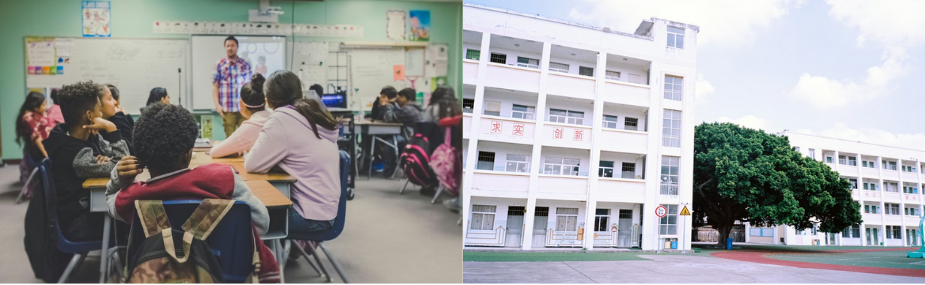
Figure 1: (Left) Students inside a classroom. (Right) Many classrooms within a big school. Image source: :https://unsplash.com/photos/man-and-woman-sitting-on-chairs-zFSo6bnZJTw; https://unsplash.com/photos/white-buildings-with-a-large-green-tree-between-them-OyO_xug0fPA
First, imagine that the students are stuck to their chairs with glue in the classroom and are unable to move. In healthy tissues, cells behave similarly – stuck tightly to other cells to stay in place with the glue that is made up of molecules called E-cadherins. However, cancer cells manage to lose their glue and leave their seats. Specifically, related to invasion, cancer cells undergo the loss of molecules such as E-cadherin, thus detaching from the original tumor. The tumor is simply an abnormal tissue.
Next, picture that the students who left their seats now want to leave the classroom, but it is completely sealed. For the students unstuck, they need to determine a way to break walls to pass through and move freely about the school, or in cancer cells case, the body. In the human body, tissues have barriers that keep the organ well organized. The most common barriers are the basement membrane and extracellular matrix. Cancer cells produce enzymes, such as matrix metalloproteinases, to break down proteins in the barriers to invade nearby tissues.
Finally, once the students leave the classroom, they need to move freely around the school, which in our analogy represents the whole body. Most healthy, normal cells are not mobile, but cancer cells can acquire the ability to move. The cancer cells gain this ability by changing the internal structure that helps push and pull themselves forward.
In summary, cancer cells have three steps to invade at early stages: losing their attachment to other cells (students no longer glued to their seats), breaking through barriers (students getting out of the sealed classroom), and beginning to move throughout the body (students going around the whole school). Altogether, these steps are the beginning of a process called metastasis. To know more about metastasis, check out the link below: https://ncdnadayblog.org/2025/03/21/metastasis/.
