By Kelly Eick
You are probably familiar with the chromosomes in your cells–the tightly wound DNA that carries your genetic code. Bacterial cells also have chromosomes that contain most of their genetic material, but many bacteria can carry extra small, circular pieces of DNA. This extra DNA is called a plasmid!
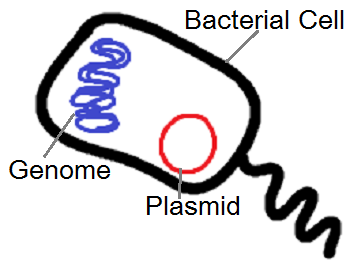
Figure 1. DNA in a bacterial cell. The image above depicts a bacterial cell with its chromosome (blue, labeled “genome” in the image) and a plasmid (red). (Image: Angelahartsock – Own work, CC0, https://commons.wikimedia.org/w/index.php?curid=42379577)
A plasmid is a small piece of DNA separate from the chromosome, and closely related bacteria can carry different plasmids. Like chromosomes, plasmids contain genes. These fall into two categories: genes the plasmid needs to replicate, and accessory genes that help the bacterium only in certain situations. Most plasmids carry genes that help them replicate independently. Accessory genes aren’t required, but they can serve a variety of functions. Common accessory genes include antibiotic resistance genes and genes that help bacteria survive stressful environments.
If you’ve ever played a card game where the goal is to get four of a kind, you have had to decide which cards to keep in your hand and which to put back. Each card you pick up might improve your hand, just as each plasmid a bacterium picks up might help it survive. Natural selection is the process by which organisms with helpful traits are more likely to survive and reproduce, much like deciding which cards to keep after each turn. Plasmids with helpful functions stay in the “hand,” while plasmids with harmful or unhelpful functions tend to be lost over time. Just as a large hand is harder to play, carrying plasmids can come at a cost. Bacteria with many plasmids may begin growing more slowly or spend extra energy on metabolic processes.
Bacteria don’t evaluate plasmids and decide which ones to pick up or lose—instead, the cost or benefit of having a plasmid influences which plasmids are kept in the population. For example, if some bacteria in a population carry a plasmid with an antibiotic resistance gene and the population is exposed to that antibiotic, the cells with that plasmid are the most likely to survive. As a result, the plasmid is passed on to each new generation as long as the antibiotic is present.
Plasmids can be transferred from one bacterium to another through several processes. One process is transformation, in which plasmids floating in the environment enter a bacterial cell. In the lab, scientists can induce transformation by heat-shocking cells, which helps plasmids enter. Another process is transduction, in which a virus that infects bacteria (a bacteriophage) can carry plasmids from one bacterial cell to another. The third process is conjugation, in which two bacterial cells in direct contact pass a plasmid from one to the other.
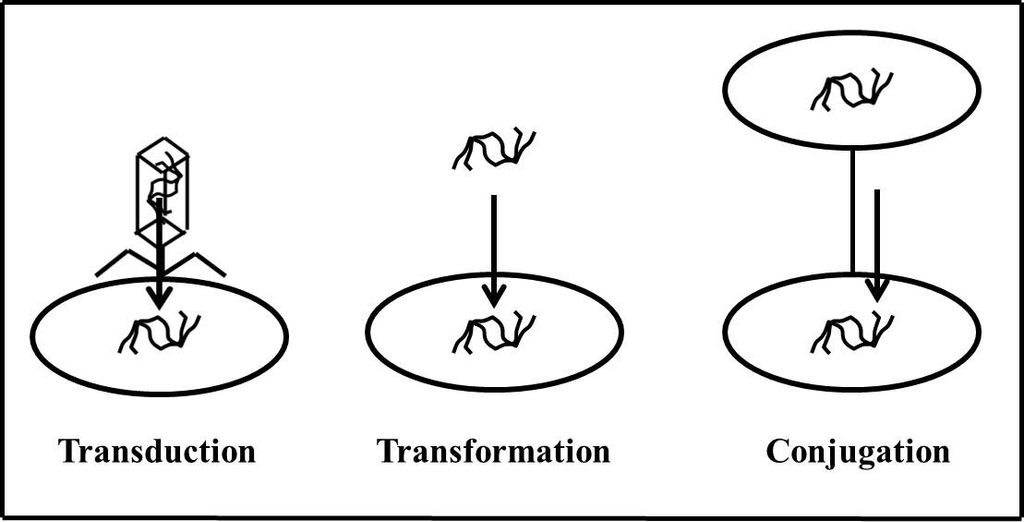
Figure 2. This image depicts three methods of plasmid transfer in bacteria: transduction, transformation, and conjugation. Image: [“Bacterial horizontal gene transfer”] by 2013MMG320B, via Wikimedia Commons, [CC BY-SA 3.0].
Plasmids give bacteria a way to gain new traits. Gaining and losing plasmids is semi-random, but natural selection shapes which plasmids persist in a population. Plasmids are tools that can help bacteria survive rapidly changing environments!

