By Jessica Zhang
The human brain is one of the most complex objects we know of in the universe. It may be hard to fathom that the structure inside your skull holds around 86 billion neurons, many of which form thousands of connections with their neighbors. This creates a network of trillions of connections—a living computer more powerful than any supercomputer ever built.
So, how does your body manage to build one?
The brain is an incredibly organized structure. Let’s zoom in on the cerebral cortex, the brain’s wrinkled, outermost layer. This is the “CEO” of your brain, responsible for your personality, your thoughts, and how you sense and move in the world.
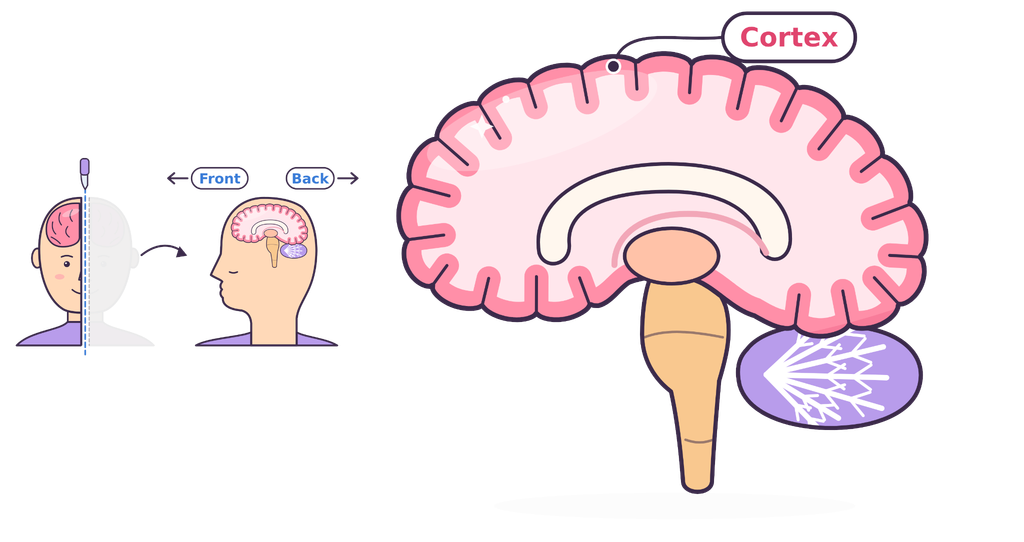
Figure 1. Sagittal view of a human brain. Slicing the head down the middle and looking at the cut side (left) reveals the sagittal view of the brain (right). The cortex (dark pink) is the brain’s thin, folded outer layer, involved in thinking and sensory perception. Images have been generated by Claude Opus 5.5.
Projection neurons – the messengers
The cerebral cortex contains many cell types, but one especially important group is the projection neurons.
If your brain were a large country, projection neurons would be the super highways. These specialized cells have long axons, thread-like extensions that act like roads, carrying messages from one place to another. In humans, a single axon can stretch to up to more than half a meter and connect distant regions with remarkable precision.
This network is highly specific. A projection neuron in your motor cortex might send its axon all the way down to your spinal cord to help move a finger, but it must not accidentally wire itself into your visual cortex. So how does this incredibly detailed wiring diagram get built during development?
Radial Glial Cells – The master builder
The answer begins with an unassuming but extraordinary cell type – the Radial Glial Cell (RGC).
RGCs are the master builders of the developing cortex. They function as stem cells, repeatedly dividing to produce the projection neurons (and other cell types) that will eventually fill the adult brain. RGCs also have a second job – they extend a long, slender, rope-like fiber from the innermost part of the brain to the outer surface. These fibers act as a scaffold for newborn neurons to climb.
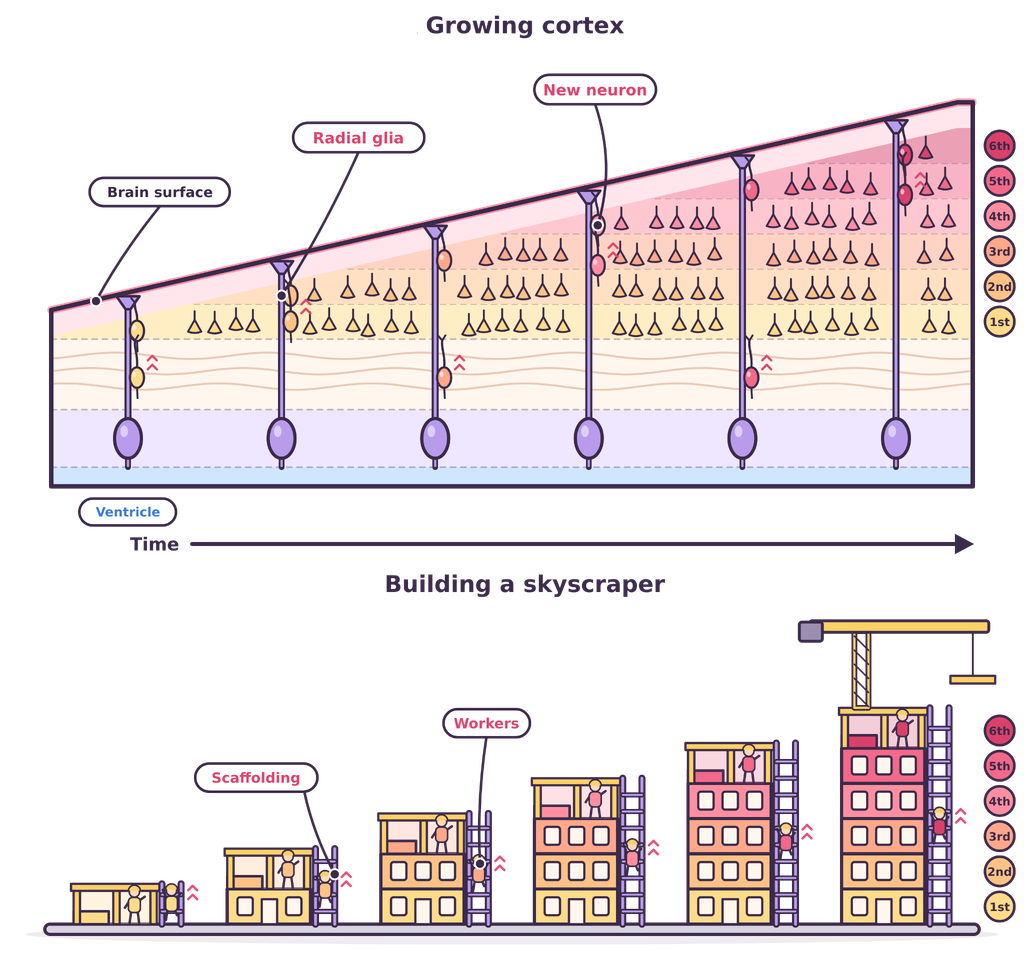
Figure 2. Newborn neurons climb radial glia fibers to the top of the growing cortex over time (top). This process is analogous to workers climbing scaffolding to build a skyscraper one floor at a time (bottom). Images have been generated by Claude Opus 5.5.
The cortex is organized into six distinct layers, stacked like the floors of a skyscraper. Just like building a skyscraper, you start by laying the foundation, then start stacking upward.
- The RGCs first form a batch of neurons that comprise Layer 6, the deepest layer of the cortex.
- Then, the RGCs create a new batch. These new neurons, like little construction workers, climb up the RGC scaffolding, past all the neurons in Layer 6, and settle just on top of them. This becomes Layer 5.
- The RGCs make another batch. These new neurons climb the RGC “ropes” past Layer 6 and Layer 5, settling on top to become Layer 4.
This process continues, with each new layer of neurons climbing past the older ones, until the final, youngest neurons climb all the way to the top to form the upper layers.
Cell Fate Specification – Neurons getting job descriptions
Once a neuron reaches the correct layer, the next question that it faces is, “what am I supposed to do here?” For example, a neuron in Layer 5 might need to send a long axon down to the spinal cord. But how does it know that?
The answer lies in a process called cell fate specification.
When a new neuron is born, it is immersed in an environment rich in chemical signals. These signals, which vary depending on the neuron’s location in the brain and the timing of cell birth, act like an instruction set. The neuron also gets a set of internal instructions that they inherit from the parent cells. Together, these instructions carry messages that tell the cell which genes to turn on and which to turn off. This unique set of genes they express ultimately determines the neuron’s final identity.
Circuit Formation – Neurons getting connected
With its identity established, the neuron now must wire itself into the brain’s circuitry. To do this, it extends its axon and begins a long journey toward its target.
Axons navigate using chemical road signs scattered throughout the developing brain. Some signals attract them, others repel them, guiding them along a precise route. The distances involved can be enormous on a cellular scale: for a tiny neuron, sending an axon longer than half a meter is like a car traveling along the highway from RTP to Charlotte!
When the axon finally locates its partner, they connect and form a synapse. This process is akin to a biological handshake, allowing information to flow from one neuron to the next.
Why it matters
Understanding how the cortex builds itself isn’t just fascinating – it’s essential. Imagine situations where the construction process goes wrong, like the “instruction set” being mistranslated or the wiring connecting to the wrong place. This can lead to developmental defects that affect the brain in various ways, impacting movement, cognition, or emotion. One example is Fragile X syndrome. When a single gene is switched off, neurons cannot produce an important protein needed to build and fine-tune their connections. People with Fragile X often experience learning difficulties and anxiety. Knowing the process of brain development will help us understand why things go wrong and how we might correct them.
Better understanding brain development can also inform brain regeneration. Currently, neurons cannot regenerate or regain proper function after injury, such as in degenerative diseases like Alzheimer’s. If we can fully understand the original instruction manual that RGCs use to build the brain, maybe we could one day use that knowledge to teach the brain how to rebuild itself.
Edited by Yasemin Cole and Karen Wang
This post was created with the assistance of generative AI tools. For a full breakdown, see this article’s documentation table.
Generative AI Documentation Table
“How Does Your Brain Build Itself?” by Jessica Zhang
Edited by Yasemin Cole and Karen Wang
| Usage | Tool Used(e.g., ChatGPT-4) | How you edited the output, if at all | Conversation Link (If available) |
| Topic selection | |||
| Brainstorming and idea generation | Claude Opus 5.5 | Suggested relevant examples for developmental disorders | |
| Research | |||
| Outlining/planning | |||
| Drafting | |||
| Media creation | Claude Opus 5.5 | All illustrative figures are generated by AI | |
| Editing/revising (Author) | |||
| Editing/revising (Editor 1) | |||
| Editing/revising (Editor 2) | |||
| Other |
