By Erick Figueroa-Ildefonso
Fun Rating: 4/5

Difficulty Rating: 3/5

What is the general purpose?
When we want to sequence the genome of an organism but our biological sample contains DNA from multiple species, it may help to enrich the DNA from our organism of interest to make it easier to analyze. We can achieve this with Whole Genome Amplification (WGA).
Why do we use it?
In the study of disease-causing organisms like the malaria parasite Plasmodium falciparum, researchers may collect blood samples from people who are infected. However, this blood will contain a higher proportion of human DNA than parasite DNA. This can be a real problem, especially when researchers deal with samples from individuals carrying a low quantity of parasites. WGA is a solution that enriches parasite DNA relative to human DNA.
How does it work?
When we work with DNA extracted from blood with a low number of Plasmodium parasites, we may want to enrich the parasite DNA to conduct other experiments, such as sequencing. To perform WGA, we will need reagents and equipment also used in a common PCR. Like in PCR, we need a polymerase enzyme, but in this case, the enzyme is called “phi29.” This enzyme catalyzes many reactions and synthesizes a new DNA strand while displacing the previous one, allowing the number of amplified DNA strands to rapidly multiply.
Step 1. DNA preparation
We begin by conducting DNA extraction on the patient’s blood sample. This DNA sample will contain a low quantity of Plasmodium DNA and a high quantity of human DNA.
Step 2. Whole-genome amplification of Plasmodium’s genome.
Since we only want to enrich the Plasmodium genome, we need to use primers that preferentially bind to it. Unlike in standard PCR, WGA primers are short (6-12 nucleotides) and bind to short DNA sequences that are common across the Plasmodium genome but rare in the human genome.
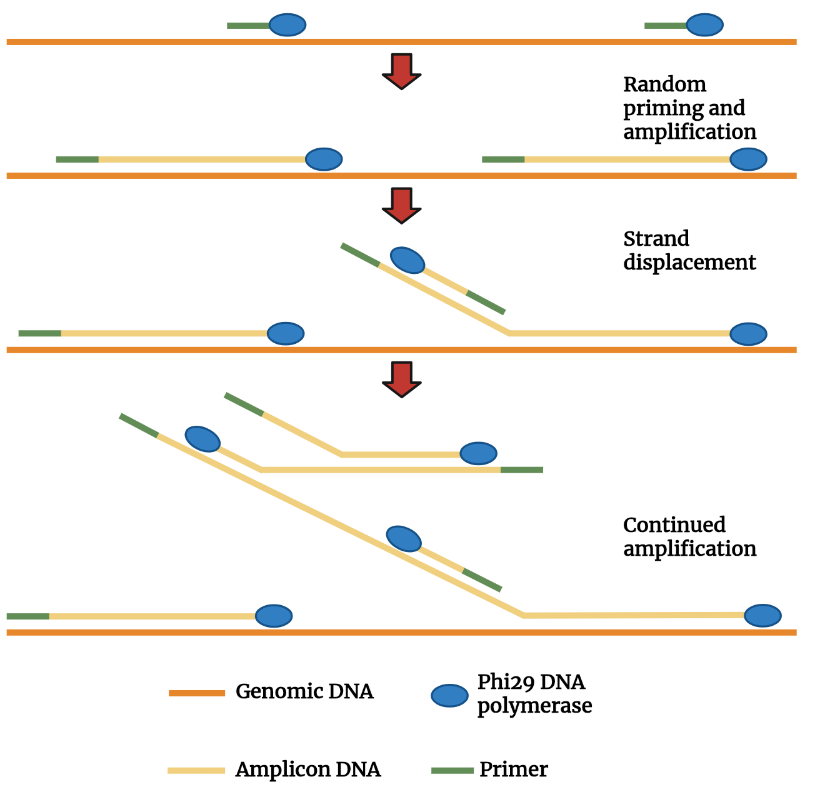
Figure 1. Schematic of multiple displacement amplification. The primers bind randomly to common sequences across the genome of interest. The phi29 DNA polymerase can push aside a synthesized DNA strand while synthesizing a new strand. Image adapted from source by the author using BioRender.
The amplification process shares some similarities with PCR. We use many of the same reagents, like primers and DNA polymerase, but the WGA polymerase requires a compound called Bovine serum albumin to protect the phi29 from denaturation. The reaction mix is prepared with the DNA and placed in a machine that controls the reaction temperature to facilitate amplification. Unlike PCR, which cycles through different temperatures, WGA is performed at a constant temperature of 30°C. Amplification can take as little as 4 hours or up to 16 hours to ensure high yield. After amplification, the enzyme is inactivated by increasing the temperature to 65°C for 10 minutes.
Step 3. DNA cleanup
After the amplification process is complete, it is necessary to recover the enriched DNA. To do so, we treat the sample with magnetic beads that bind to long DNA sequences. An additional magnet is then used to separate these strands from reaction residues and short DNA molecules. These unwanted residues and molecules are then washed out of the sample.
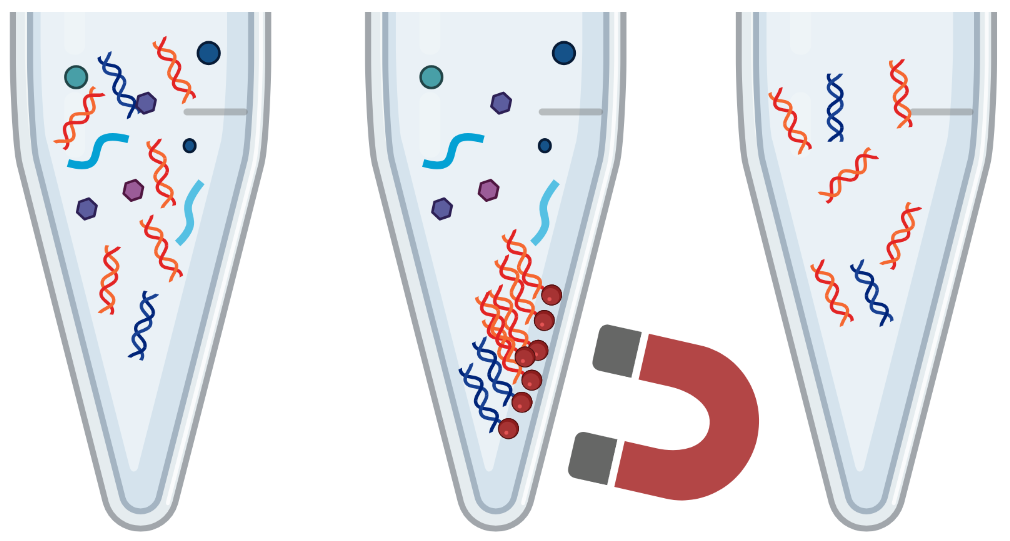
Figure 2. DNA cleanup after WGA. Orange corresponds to the Plasmodium DNA, while blue is the human DNA. Image created by the author using BioRender.
Once the DNA is isolated, we can use it for sequencing or other molecular procedures that require more DNA than the original sample contains. Although the recovered DNA will still contain human DNA, the Plasmodium DNA will be present in a greater proportion than it was initially, which facilitates its study. Researchers have used WGA when studying the whole genome of Plasmodium to identify mutations associated with resistance to antimalarial drugs, identify how the parasite spreads, and study their evolution.
