By Sarah Angle
What is a theranostic? A theranostic is a drug that has two functions: treatment and diagnosis. The term combines “therapy” and “diagnostic” and was coined in a 1998 press release. Rather than just delivering a treatment, a theranostic provides information about where and when the drug is active, most commonly through a fluorescent readout. To achieve this precise tracking, these agents are often selectively “turned on” in one area. Ultimately, this dual-action approach transforms medicine by letting doctors see and treat disease at the same time.
Why is it helpful? Most drugs act systemically, meaning they act throughout your entire body. This often results in off-target toxicity in places where the drug is not meant to act. Additionally, treatment success is often hard to assess immediately, as it is generally measured by outcomes such as physical size changes and negative test results. Instead, theranostics can provide real-time tracking of drug release, offering insights into therapy delivery. If a doctor does not observe drug release, most commonly as fluorescence, or if the drug release is off-target, then they can switch to a different therapy immediately.
Where are theranostics currently used? The most established use of theranostics is in cancer treatment. For example, doctors can first use an imaging agent to identify tumors and then follow up with a related treatment that delivers radiation. A recent study showed how powerful this is: a new radioligand therapy called ¹⁷⁷Lu-PSMA-617 extended the average survival time for prostate cancer patients by four months, increasing from 11.3 to 15.3 months. Theranostic strategies are also explored for other diseases, including inflammatory conditions such as arthritis.
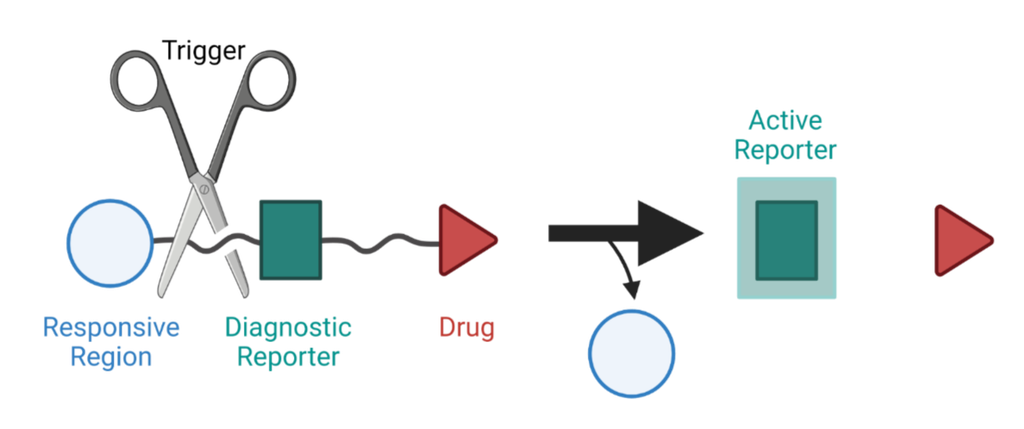
Figure 1. An example theranostic with a responsive moiety, diagnostic reporter, and drug. The trigger (represented by scissors) cleaves the responsive region, activates the reporter, and releases the drug. Image created by the author using BioRender.com.
How are theranostics “turned on”? Some theranostics are designed to remain inactive until they encounter a trigger that is more common at a disease site than in healthy tissue, similar to how a prodrug is activated (Figure 1). A trigger may be an enzyme, acidic environment, or reactive molecule associated with the disease. In these systems, the theranostic often has three main parts: a responsive region, a diagnostic reporter, and a drug.
Want to learn more? Visit this website or watch this video to dive a little deeper into theranostics.
