(noun. /al-oh-STAY-sis/)
by Hazel Milla
What does it mean?
When the environment changes, your body does its best to remain regulated. It does so through two primary mechanisms: allostasis and homeostasis. With allostasis, the body adjusts its internal setpoint in response to sources of stress, also called stressors (note that stressors can be emotional, such as public speaking, or physical, such as pollution). Levels of stress mediators (biological factors that respond to stress), including blood pressure, stress hormones, and inflammatory protein concentrations, change in response to stressors. While this allostatic response is adaptive in the short term, prolonged activation of the stress response can lead to long-term adjustments to the body that may contribute to disease.
Unlike allostasis, which changes the body’s baseline state in response to stress, homeostasis works to return the body to a set baseline, which usually falls within a range. For example, when your body temperature drops too low, you may experience shivering. This is a homeostatic mechanism; its goal is to bring the body back to an ideal internal temperature. While the target state may not be identical for every situation (for example, body temperature varies based on whether you are asleep or awake), it remains relatively fixed. Think of a dartboard nailed to a wall; while homeostasis won’t always hit the bullseye, it’ll always target the same general area.
Unlike homeostasis, which only responds to environmental changes as they arise, allostatic regulation also occurs in anticipation of these changes. If you are exposed to stressors for extended periods of time, your nervous system adjusts to this environment by treating it as the new normal and remaining primed in anticipation of more stress. As a consequence, your blood pressure and stress hormone levels may remain high even after the stressful situation is over, and your setpoint changes accordingly. While this can be a useful response temporarily, it becomes harmful when stress persists beyond what the body can handle. When demands from stress exceed the body’s ability to adjust, the body begins to break down and is at a greater risk for disease. The “wear and tear” that occurs to the body as a result of stress is called “allostatic load.” When this load is excessive enough to cause damage, it is referred to as “allostatic overload.”
How do I use it in a sentence?
“When exposed to chronic stress, the body relies on allostasis to adjust to its environment.”
“Factors like financial instability and workplace stress can increase allostatic load, contributing to disease risk.”
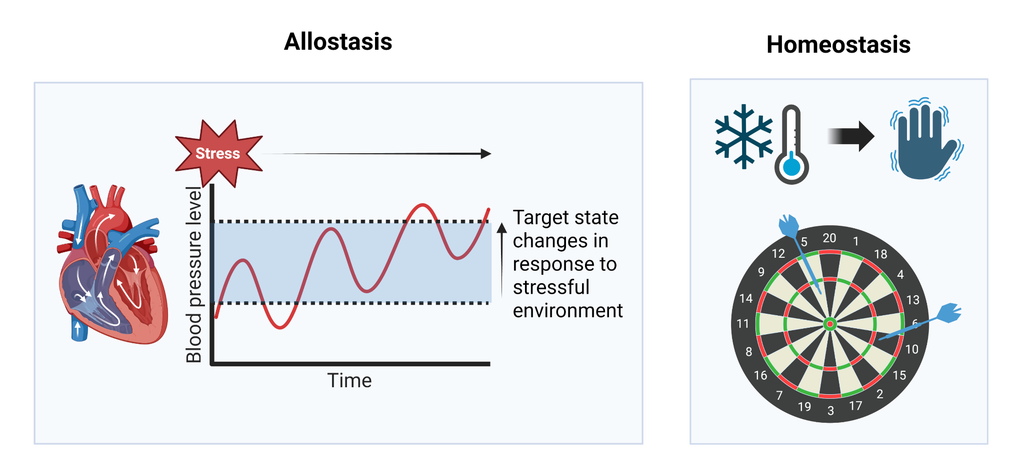
Figure 1. Visuals illustrating the difference between allostasis and homeostasis. With allostasis, blood pressure (a stress mediator) rises, fluctuating around a certain setpoint. This setpoint increases with prolonged exposure to stress. As a consequence, baseline blood pressure remains high. For homeostasis, factors like excessive cold induce shivering. Homeostatic mechanisms aim for certain setpoints, which can vary based on context. For example, body temperature varies based on where you are in your sleep-wake cycle. This range of biological setpoints can be visualized as the area on a dartboard. Graphic created by the author using BioRender. Allostasis graph adapted from source; additional graphic from source.
Etymology
“Allo” and “stasis” come from the Greek words “állos,” meaning “other,” and “stásis,” meaning the state of standing. By contrast, “homeo” from homeostasis comes from the Greek word for “same.”
History of usage
In 1988, Peter Sterling and Joseph Eyer first defined “allostasis” as the body’s dynamic process of responding to stress. In 1993, Bruce S. McEwen and Eliot Stellar built on this concept by introducing the term “allostatic load” to describe the wear and tear that occurs to the body as a result of allostatic responses.
Related terms
Homeostasis
Stress
Fields of study in which this word is commonly used
Medicine
Stress biology
Psychology
Endocrinology (the study of hormones)
Neuroscience
Edited by Ericka Ekobeni and Sarah Angle
No generative AI was used in the creation of this post.

