by Fahmida Alam
Think of human memory: it stores information so we can learn from past experiences. Similarly, certain cells in our immune system retain memory of responses to pathogens and vaccinations. This powerful feature, called immunological memory, allows the body to respond faster and more effectively to subsequent infections.
Immunological memory is the result of lymphocytes (LIM-foh-sites) of the adaptive immune response, mainly B and T lymphocytes, responding to a specific antigen and storing the information as memory B and T cells in the human body.
Memory B cells and memory T cells play different but complementary roles in protecting the human body. The lymphatic system, comprising organs (thymus, bone marrow, lymph nodes), vessels, and tissues (Image 1), plays important roles in the response of B and T lymphocytes. Other lymphoid organs include Peyer’s patches in the intestine, bone marrow, and spleen.
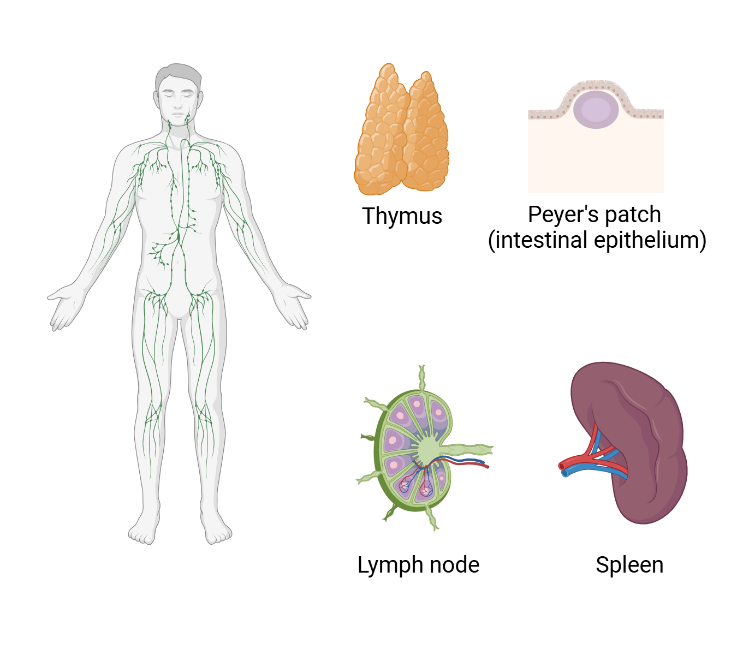
Image 1. Human lymphatic system (left). Cross-section of a lymph node and some of the major lymphoid organs, such as the thymus, Peyer’s patches, and the spleen (right).
During infection and vaccination, naïve B cells in the lymphatic system bind antigen via their B cell receptors on the cell surface. These activated B cells proliferate quickly, and they differentiate into antibody-producing plasma cells and memory B cells. When infected with the same or similar extracellular pathogens, these memory B cells recognize the pathogen, rapidly activate, and either differentiate into antibody-secreting plasma cells or memory B cells, providing rapid protection. The development of long-lived memory B cells is a key strategy in vaccination.
Memory T cells are also generated from naïve T cells; there are two types: CD4 and CD8 T cells. T cells also have receptors on their surface called the T cell receptor; however, unlike B cells, these cells cannot use the receptors to directly recognize antigens. They need the help of antigen-presenting cells (APCs) to recognize an antigen, get activated, and expand the number of activated cells. After the pathogen is cleared from the body, a portion of these activated T cells remains in the body as memory T cells. When humans are infected with the same or similar pathogens, antigens are presented by the APCs. As a result, memory T cells are activated quickly, they secrete cytokines, and act rapidly to clear infections.
In many ways, immunological memory acts like a personal health history written into your immune cells. Each encounter teaches the immune system how to respond better next time. Together, memory B and T cells ensure that when familiar invaders return, your body is not caught off guard—it’s ready.
