by Sarah Angle
Fun Rating: 3/5

Difficulty Rating: 3/5
What is the general purpose?
A checkerboard assay is useful for varying the concentrations of two agents to identify the optimal combination for in vitro activity.
Why do we use it?
Checkerboards allow us to assess whether combining agents, such as drug treatments or metal complexes, provides greater biological activity than using either agent alone. This allows identification of the concentration combination that yields the greatest biological effect.
How does it work?
To set up a checkerboard, one agent is microdiluted across the columns of a 96-well plate, and the other across the rows. This results in a two-dimensional grid of concentration combinations so that no well is equivalent. Each well is then seeded with the biological component (most often cells) and incubated for a period of time. After incubation, growth activity, or another biological readout is measured to evaluate the effect of each combination.
A checkerboard assay is similar to testing every combination of two recipe ingredients, with one ingredient varying across rows and the other across columns. Each well reveals which combination gives the best outcome for your dish.
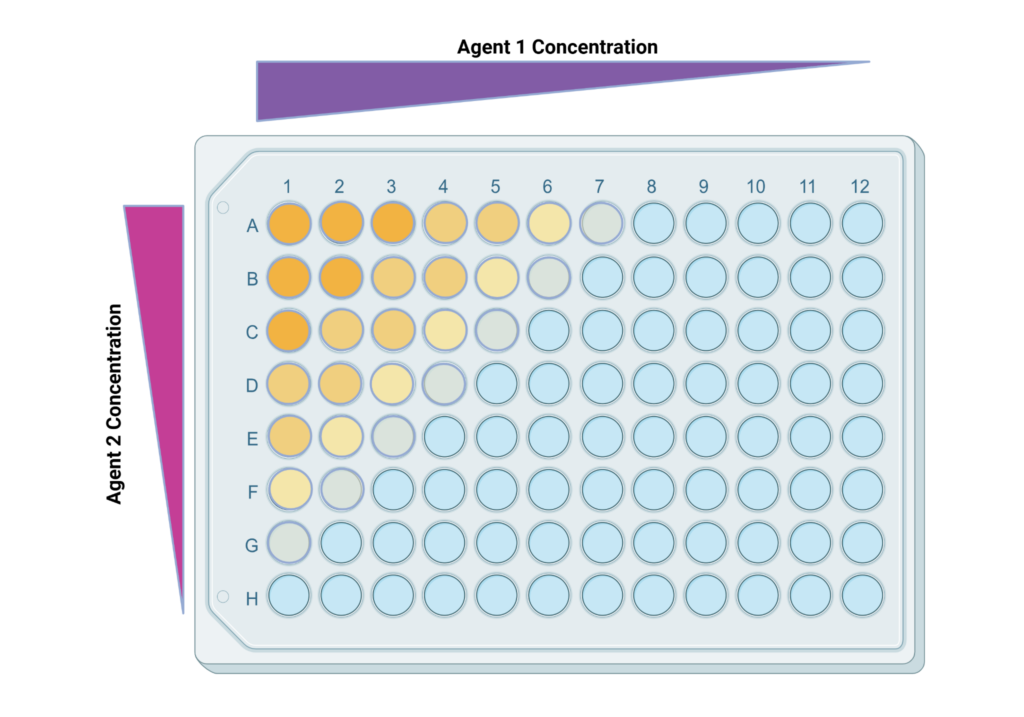
Figure 1. In the checkerboard assay layout, Agent 1 decreases in concentration from left to right (purple gradient) while Agent 2 decreases from top to bottom (pink gradient). After incubation, wells with the highest concentrations of both agents (orange wells) show the greatest biological response.
Image created by the author using BioRender.com.
Edited by Henry Kitiabi
