by Claire Greene Whitfield
If the bubonic plague sounds familiar to you, it is probably from history class – not your biology courses. From 1347 to 1351, a pandemic later known as the Black Death spread throughout medieval Europe and Asia. It is estimated to have killed one to two-thirds of Europe’s population at the time. It may surprise you to know that the biology of this major epidemic is still being studied today!
The bubonic plague is one of three types of plague caused by the bacterium Yersinia pestis (Fig. 1). When these bacteria can quickly replicate in the lymphatic system, it causes lymph nodes to swell dramatically into lumps under the skin called buboes (Fig. 1). The bubonic form is the most famous and the type that caused the Black Death. The type of plague is determined by the tissue that the Y. pestis bacteria infects. The other two types, Yersinia pneumonae and septicemic, are caused by infections of the lungs and blood, respectively.
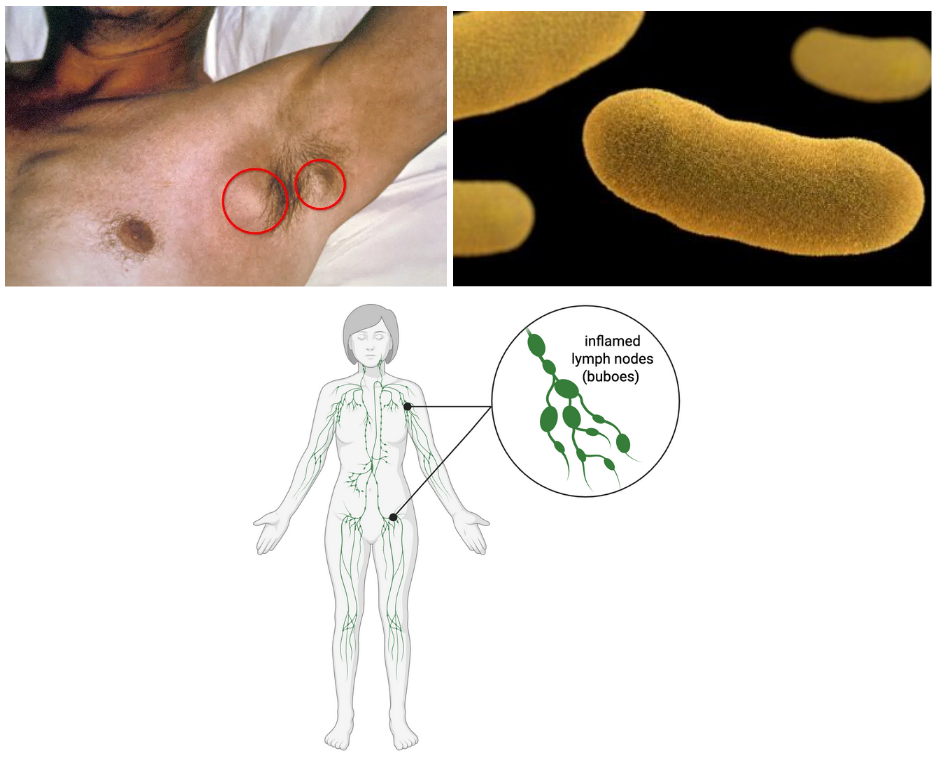
Figure 1. Top Left – Buboes in the underarm region (image source). Top Right – Yersinia pestis bacterium (image source) Bottom – Lymphatic system depicting inflamed lymph nodes in key areas like the underarm and groin (created by the author in BioRender).
Most historians and scientists agree that the first plague infection was likely transmitted to humans from an infected flea. To this day, the bacterium is frequently transmitted among rodent populations by fleas but can occasionally jump to humans. Sometimes, pets will become infected and even transmit the bacteria to their owners. From there, bodily fluids like blood or respiratory droplets can be passed from infected to non-infected people, causing further spread of the plague.

Figure 2. Map of the United States showing reported cases of human plague between 1970 and 2023. Most cases from the past 50 years are clustered in the southwest region, where Y. pestis is more likely to be found in rodent populations – Data and graphic from CDC.
Should we be concerned about the plague in the 21st century? People do get the bubonic plague today, but in developed countries like the U.S., it is far less severe (Fig. 2) and easily treated with antibiotics. The CDC (Centers for Disease Control and Prevention) simply cautions people in the southwestern U.S. to be careful if they have pets in an area where Y. pestis is in circulation. It is important to note that other countries, such as Madagascar, still experience more severe plague outbreaks. This is one reason scientists still study it to understand better the infection and how it continues to spread.
The bubonic plague of the 12th century was a landmark epidemic that had far-reaching impacts on agriculture, politics, economics, and medicine. At the time, very little was known about how disease spread amongst people. Doctors of the era suggested that an imbalance in people’s humors (blood, yellow bile, black bile, and phlegm) caused illness. Literature from the time of the Black Death explains that people tried anything and everything to treat the plague; some even thought that unicorn horns would cure them! Thankfully, modern medicine and fields like epidemiology have tools and information that prevent large outbreaks of the plague from happening again.
Fun Fact: Many historical images shown in association with the Black Death are actually of other diseases, such as leprosy or smallpox. You can read about accurate historical representations of plague here.
