by Emily DiMaulo-Milk
In 2026, an estimated 5,800 Americans will be diagnosed with cancer each day. You probably know someone who was diagnosed with cancer, maybe even someone in your family. Having a relative with cancer may have made you worry about getting cancer. Fortunately, just because a family member had cancer doesn’t mean you will also get cancer. This is even true for identical twins! In fact, cancer is caused by the complex interaction of many different factors. The risk factors for cancer are both inherited and environmental.
Inherited risk factors are genetic traits that you get from your biological parents. Genetics account for things like eye color and hair texture. Every person is unique due to differences in their genetics called polymorphisms. Polymorphisms that you are born with are called “germline polymorphisms.” You inherit two copies of each gene, one from each parent, so you can have two different polymorphisms for the same gene. Besides appearance, genetics shape biology in many invisible ways. Sometimes, polymorphisms are in genes that control cell growth or response to stress. These can increase the risk of cancer. One example is a polymorphism in the BRCA1/2 gene. Women who inherit a harmful polymorphism in BRCA1/2 have a~3.5-5x higher rate of breast cancer.
If your mom had breast cancer, she may have been tested for a BRCA1/2 polymorphism, and you might be scared that you inherited it. If someone knows they have the harmful polymorphism, a doctor will help them decide what is best. When someone has the harmful BRCA1/2 polymorphism, they still have a healthy polymorphism that they inherited from their other parent (your grandparent). So, even if your mom has the harmful polymorphism, it’s not guaranteed you do too. Additionally, inheritance alone isn’t enough to cause cancer. The healthy polymorphism usually compensates for the harmful one which is why not everyone with a harmful BRCA1/2 polymorphism gets cancer. In order for cancer to develop, something must cause the healthy polymorphism to stop working. Other genes recognize when a cell has become pre-cancerous and will trigger the death of that cell in response. Additional harmful changes in these genes are often required for cancer to fully develop.
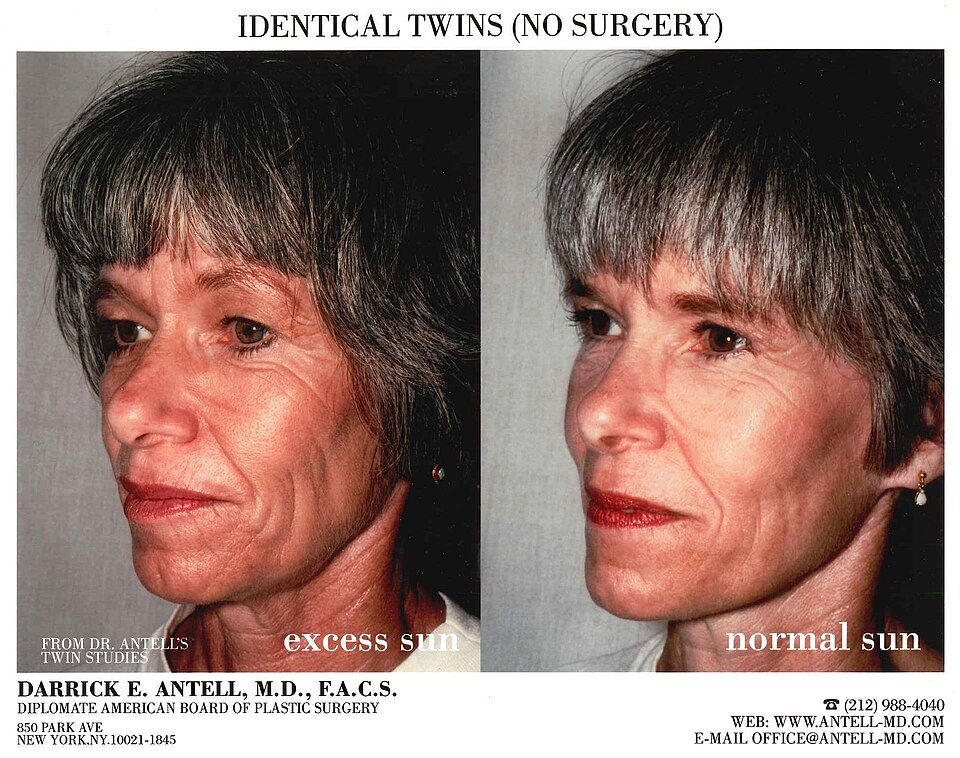
These two women are identical twins, but they appear to be different ages. While their germline polymorphisms are the same, the woman on the left spent a lot more time in the sun. This is an example of how environmental factors influence a person’s body. Image “Twins – Gay and Gwyn, Sun exposure” is licensed from Dr. Darrick Antell under CC-BY-SA-4.0.
As they age, people accumulate changes in their genes called “mutations.” Unlike germline polymorphisms, these mutations aren’t shared across cells or passed to children. Sometimes, a mutation can “break” a gene. For those with two healthy polymorphisms, both need to “break” in the same cell, which is called the “two-hit theory.” In people who inherited one harmful polymorphism, they only need to experience one “hit” in any cell. This is why their risk of cancer is higher, but it is still not a certainty. This is how environmental factors contribute to the development of cancer. Environmental factors that increase the risk of cancer are “mutagenic”, meaning that they increase the likelihood of a mutation occurring. They include certain infections, pollution, sunlight, and toxic chemicals in cigarettes and vapes. An environment that promotes mutations makes it more likely that a “hit” will occur. In this way, inherited and environmental risk factors interact to cause cancer.
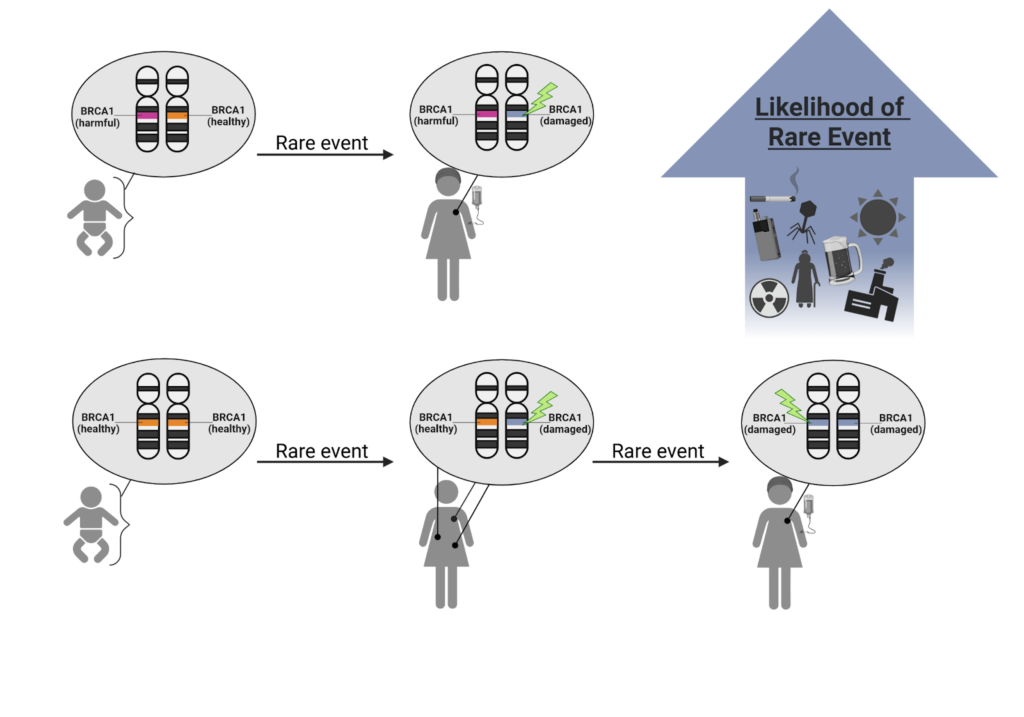
The two-hit theory of cancer suggests that both copies of a gene must be non-functional for cancer to occur. For a person born with one harmful germline polymorphism (top, pink), only one rare mutational event must occur for cancer to develop. On the other hand, for someone born with two healthy polymorphisms (bottom, orange), an initial rare event must damage one copy of a gene. The second rare event must occur in a cell that already has a damaged copy of the gene to cause cancer. The likelihood of a rare event can be increased due to the environment, advanced age, diet, tobacco/alcohol use, and certain infections. Created in BioRender. DiMaulo-Milk, E. (2026) https://BioRender.com/31de524
Overall, the genes a person is born with contribute to their risk of getting cancer, but cancer itself can’t be inherited, and genetics are far from the only factor that decides if a person will get cancer. While you can’t change the genes you’re born with, you can make healthy choices every day, like getting vaccinated for HPV, wearing sunscreen, or quitting smoking/vaping, to reduce your risk of getting cancer.

